AI Job Market in Canada 2026: What Is Really Happening and How to Navigate
Written by Madina · Published · Updated
The Canadian Job Market in 2026 Is Not What People Expected
A lot of people entered 2026 expecting AI to have either created a wave of exciting new jobs or eliminated a frightening number of old ones. The reality, as usual, is more complicated and more interesting than either headline.
The Canadian job market is not in freefall. It is not booming either. It is shifting - quietly, unevenly, and in ways that are genuinely difficult to separate from other forces like immigration policy changes, the Canada-U.S. trade situation, and the long tail of post-pandemic labour market adjustments. If you are a job seeker trying to make sense of what is happening and what it means for your next move, this article is for you.
What the Numbers Actually Say
Start with the basics. Canada's unemployment rate held steady at 6.7 percent in March 2026, with employment edging up by 14,000 jobs month-over-month - a modest gain that reflects a market moving slowly rather than collapsing or surging. Robert Half
That steadiness masks some important dynamics underneath. The Canadian labour market has been characterised by a "low hire, low fire" pattern - over the three months through November 2025, the layoff rate was down 9 percent from its 2017-2019 average, but the hiring rate was down 22 percent over the same period. In plain terms: fewer people are losing jobs, but fewer openings are being created. For job seekers, that second number is the one that stings. Indeed Hiring Lab
AI is part of the story, but probably not in the way most people assume. Statistics Canada research suggests AI has not yet caused broad job losses, even in occupations with high AI exposure. But employment growth has been weaker for younger and less-educated workers from 2022 to 2025 - the period when tools like ChatGPT became widely available. The technology is reshaping who gets hired for what, more than it is eliminating jobs outright - at least so far. Canadian Affairs
How AI Is Actually Reshaping Canadian Work in 2026
The clearest signal of where things are heading is in the language employers use. Mentions of artificial intelligence in Canadian job postings nearly doubled over the past year. That shift is not limited to tech roles. It spans finance, marketing, healthcare, customer service, and administrative functions. AI is no longer a specialist concern - it is becoming a baseline expectation across industries. Indeed Hiring Lab
References to generative AI in particular doubled in Canadian job postings, with generative AI mentioned in 2.4 percent of roles - particularly in software development and related technical fields. In some cases, AI tools are reducing development timelines by 20 to 30 percent. That productivity shift has real implications for hiring volumes. When a developer using AI can do in a day what used to take three, companies do not always hire three people - they hire one and expect more output. SISystems
The Four Types of Jobs in the AI Era
TD Economics published a useful framework for thinking about how different roles relate to AI, and it is worth understanding before you apply anywhere.
The framework divides jobs into four categories based on two questions: how exposed is the role to AI, and does AI complement the work or replace it?
High-Exposure, High-Complementarity
- roles like engineering, data science, healthcare, and senior marketing. AI makes these workers more productive and their skills more valuable. Salaries in these areas are rising.
High-Exposure, Low-Complementarity
- roles like data entry, administrative support, and certain clerical functions. These are positions where AI is more likely to automate routine digital tasks. They tend to offer lower wages and face greater risk of disruption.
Low-Exposure, High-Complementarity
- roles like nursing, trades support, and client-facing service work where AI assists but cannot replace the human element.
Low-Exposure, Low-Complementarity
- some manufacturing and physical labour roles, where automation rather than AI is the bigger long-term concern.
If you are planning a career move or trying to assess your current position, honestly placing yourself in one of these categories is a more useful exercise than worrying abstractly about "AI taking jobs."
The Clerical and Administrative Shift
This one deserves its own mention because it affects a lot of people. Research director Tricia Williams at the Future Skills Centre noted that clerical and administrative roles are already seeing fewer positions, because many of those tasks are being complemented by AI. Where before one admin might support two executives, they can now support four - because AI productivity tools handle more of the routine work. Canadian Affairs
That is not a collapse of the administrative profession. It is a compression. Fewer total positions, but the ones that remain require broader capability and more comfort with technology. If you work in this space, building competency with AI tools is not optional - it is the thing that keeps you on the right side of that compression.
Canada AI Recruitment Market: How Artificial Intelligence Is Reshaping Hiring in 2026
Which Sectors Are Still Actively Hiring in Canada
Despite the broader slowdown in hiring rates, certain sectors are genuinely expanding. Knowing where the growth is matters more right now than generic job search advice.
Technology and IT
According to Robert Half Canada's Demand for Skilled Talent Report, 48 percent of technology and IT hiring managers plan to increase hiring in 2026 - with only 5 percent saying they already have the headcount and skills needed to meet their targets. That gap between ambition and capacity is where opportunities live. Robert Half
The most evident skill gaps in tech teams right now are in AI and machine learning, cybersecurity, and cloud adoption - as Canadian businesses seek flexibility, scalability, and cost savings through digital infrastructure. If you have these skills, the market for you is considerably better than the headline unemployment rate suggests. Robert Half
Healthcare
Healthcare is one of the sectors where AI plays a strongly complementary role rather than a replacement one. Demand for clinical professionals, health data analysts, and healthcare technology specialists is growing consistently. The combination of an aging population, ongoing digital transformation of hospital systems, and the retirement of Baby Boomer healthcare workers creates sustained demand that is largely insulated from the AI disruption affecting other sectors.
Professional and Financial Services
60 percent of hiring managers across professional fields plan to add permanent staff in the first half of 2026, and 55 percent expect to bring in contract talent to support immediate needs. The caveat is specificity - these hires are concentrated in roles tied to AI adoption, digital transformation, and business growth. Generic roles without a clear productivity angle are harder to fill with budget approval right now. Robert Half
Skilled Trades
This is the quiet story of the Canadian job market that does not get enough attention. Trades roles face far lower AI exposure than most professional occupations, and demand across construction, electrical, plumbing, and industrial sectors remains strong. The digital transformation wave that is reshaping office work has not reached the job site in the same way. For anyone considering a career path or transition, trades credentials carry significant protection against the disruption affecting other sectors.
The AI Literacy Divide - and Why It Matters for Your Resume
If there is one capability that has moved from "nice to have" to genuinely career-driving in 2026, it is AI literacy - the ability to understand, apply, and critique AI as part of everyday work. Employers are increasingly thinking about talent through this lens, and it is influencing how roles are defined, how candidates are evaluated, and how teams operate once someone is hired. Robert Half
This creates a practical challenge for job seekers who have been using the same resume format and language for years. The roles themselves have changed. The skills employers want have shifted. But many resumes still describe work the way it was done in 2021.
A student at the University of Lethbridge noted that his university actively coaches students on how to navigate AI-driven hiring systems - including how to place the right keywords on a resume to pass automated screening, and which terms to avoid that trigger rejection. That kind of coaching used to happen only at elite institutions or through paid career services. The fact that universities are now building it into standard curriculum signals how mainstream this challenge has become. Canadian Affairs
For newcomers to Canada and PGWP holders, this layer adds to an already complex navigation challenge. Not only do you need to frame your international experience in terms Canadian employers recognise - you also need to do it in the specific language that ATS systems are scanning for in 2026. The vocabulary of AI-adjacent work (prompting, workflow automation, AI-assisted analysis) is appearing in job descriptions across sectors. If your resume does not reflect fluency in this language, even indirectly, it can look out of date before anyone reads it.
Tools like CVMaple are designed specifically to close that gap. The ATS scoring feature shows you how your resume measures against a specific job posting - not in the abstract, but against the actual keywords and structure the employer's system is looking for. For job seekers trying to break into the Canadian market or pivot into roles that require updated positioning, that kind of real-time feedback changes how you approach every application.
The Harder Truth About Entry-Level in 2026
This needs to be said plainly. 64 percent of business leaders say AI-generated applications are making the hiring process more challenging - meaning the volume of applications has increased, but the quality signal has gotten harder to read. Recruiters are getting more submissions and trusting fewer of them. That is not a great environment for entry-level applicants who need to stand out on limited experience. Robert Half
Jobs with high AI exposure are more likely to be higher-paying, full-time, and permanent - meaning AI-driven change, if it leads to job losses, could involve the loss of high-quality positions, not just low-wage work. That is the uncomfortable undercurrent of the current moment. The disruption is not concentrated at the bottom of the pay scale. It reaches into professional, managerial, and knowledge-worker roles that many people assumed were safe. Statistics Canada
The response is not panic. It is preparation. The job seekers doing well right now are the ones treating their resume as a living document - updated for each application, tailored to the language of the role, and benchmarked against what AI screening systems actually look for.
What You Can Do Right Now
The market is competitive. That is not going to change in the near term. But competitive markets reward preparation, and most job seekers are still not doing the basics well.
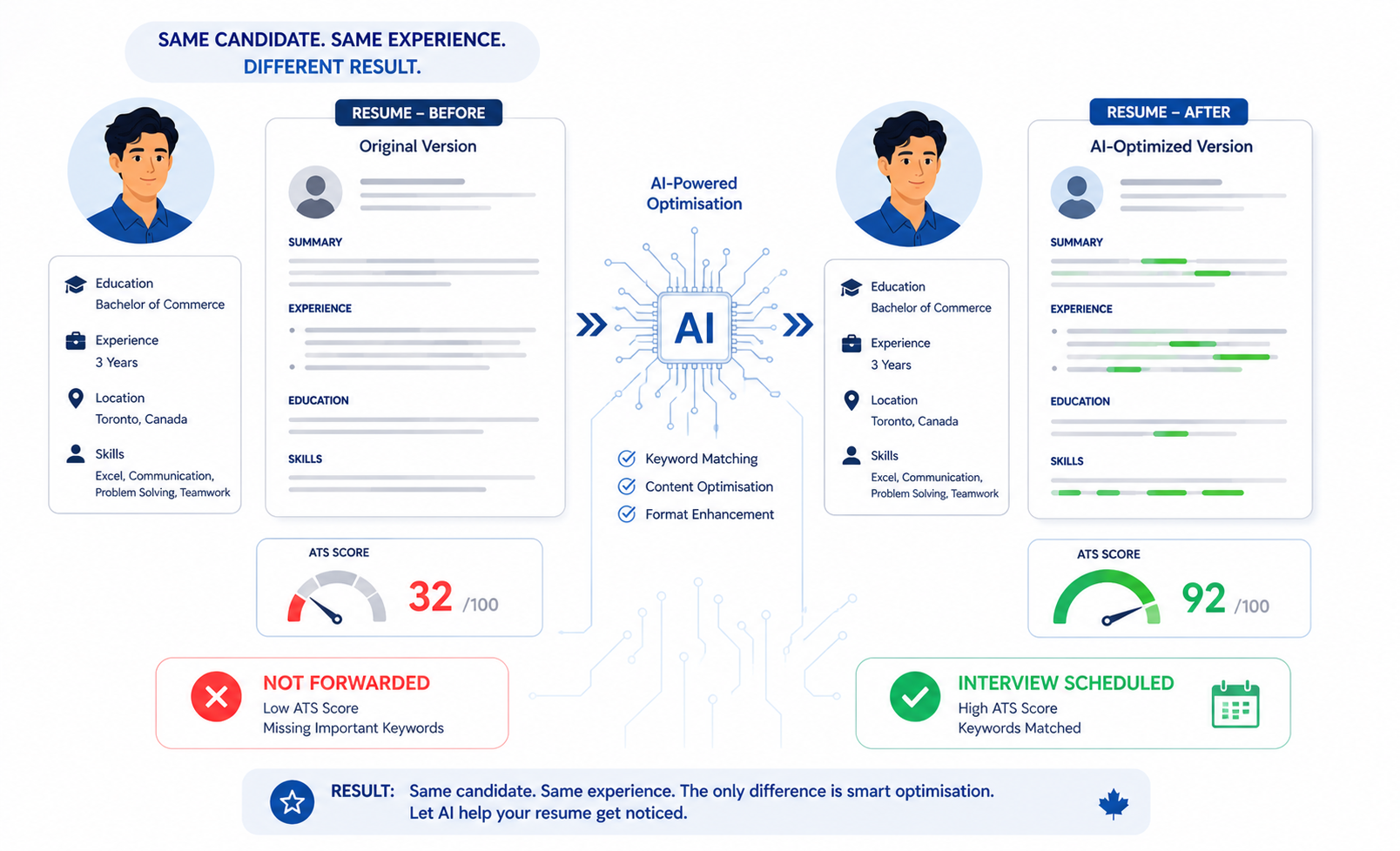
A few things that make a measurable difference in 2026:
Tailor every application.
A generic resume sent to 50 companies gets worse results than a tailored one sent to 10. ATS systems score keyword match, and a resume optimised for one job description will consistently outperform a general one.
Add AI literacy to your resume honestly.
If you use AI tools in your work - for writing, analysis, research, coding, customer communication - say so specifically. Name the tools. Describe the context. Employers are scanning for this.
Update your LinkedIn profile.
Recruiters in Toronto, Vancouver, and Calgary are sourcing candidates through AI-powered LinkedIn tools. An outdated or sparse profile effectively makes you invisible to a significant portion of the hiring market.
Run an ATS audit before you apply.
You cannot fix a keyword gap you cannot see. Tools like CVMaple let you check your resume against the actual job posting before it goes out - which is the kind of preparation that used to require a paid recruiter.
Key Takeaways
Canada's unemployment rate sits at 6.7 percent in 2026 - stable, but with a notably slow hiring rate that makes job searching harder than the headline suggests.
AI has not caused mass layoffs yet, but it is reshaping which roles get created, which get compressed, and what skills employers prioritise.
Technology, healthcare, skilled trades, and professional services are the sectors with the most active hiring.
AI literacy is no longer optional - it is appearing in job descriptions across all industries and influencing how candidates are evaluated.
Newcomers and PGWP holders face a compounded challenge: framing international experience for Canadian employers while also aligning with AI-era skill expectations.
Tailored, ATS-optimised applications consistently outperform generic ones in the current market.
The job market is genuinely harder to navigate than it was three years ago. But the tools available to job seekers have also improved. The gap between a poorly optimised application and a well-prepared one has never been wider - or more worth closing.
FAQ
Q: Is the AI job market in Canada growing in 2026? A: Yes, but unevenly. Roles that require AI skills - particularly in technology, data, financial services, and healthcare - are seeing strong demand. Meanwhile, roles involving routine digital tasks like data entry and basic administrative work face compression as AI tools automate parts of those functions. The overall hiring rate in Canada is still below pre-pandemic levels, making competition intense across most fields.
Q: Which jobs are most at risk from AI in Canada? A: Roles classified as high-exposure and low-complementarity face the greatest risk. This includes data entry, routine administrative support, basic customer service scripting, and some clerical functions. These are positions where AI can replicate or absorb a significant portion of the core tasks. Skilled trades, clinical healthcare, and roles requiring complex human judgement remain far less exposed.
Q: What AI skills should I add to my Canadian resume in 2026? A: Be specific and honest. If you use AI tools for writing, code generation, data analysis, customer communication, or workflow automation, name them and describe how. Employers are scanning for terms like prompt engineering, generative AI, AI-assisted analysis, workflow automation, and specific tool names like Copilot, ChatGPT, or Midjourney where relevant to the role. Vague claims like "familiar with AI" carry little weight.
Q: How does AI affect the Canadian job search process itself? A: Significantly. Most mid-to-large Canadian employers use ATS systems that screen and rank resumes before a human sees them. AI-powered sourcing tools also scan LinkedIn profiles to identify passive candidates. Job seekers who understand how these systems work - and tailor their resumes and profiles accordingly - consistently get better results than those who do not.
Q: Is it harder to find a job in Canada as a newcomer in 2026? A: The "Canadian experience" barrier remains real, and it now has an added layer: newcomers need to frame their international experience in language that both Canadian employers and ATS systems recognise. The good news is that AI-powered resume tools like CVMaple are specifically designed to help with this - translating strong international backgrounds into the format and terminology the Canadian job market expects.
Conclusion
If you are navigating the Canadian job market in 2026 and not getting the responses your experience deserves, the gap is often not your qualifications - it is how your resume is presenting them to the systems screening it first. CVMaple's free resume audit gives you an ATS match score against any job posting, highlights missing keywords, and flags formatting issues that could be costing you interviews before anyone reads your name.
For newcomers, career changers, and anyone who wants to apply with confidence rather than guesswork, CVMaple Pro goes further - with full job-specific optimisation, before-and-after ATS scoring, and cover letter generation tied to the same resume. In a market where 64 percent of employers say application volumes are making hiring harder, a well-optimised resume is not a small advantage. Start free at cvmaple.ca and see exactly where you stand.
About the author
Madina is an author at CVMaple, writing about tailoring a resume to each job posting and how AI is changing the job market in Canada.
Spotted something out of date? Tell us at support@cvmaple.ca.