How to Convert Your CV to a Canadian Format ATS-Friendly Resume (Step-by-Step Guide)
Written by Mathew · Published · Updated
How to Convert Your CV to a Canadian Format ATS-Friendly Resume (Step-by-Step Guide)
You spent years building your career. You have the degrees, the experience, the results. And yet, you are applying to Canadian jobs and hearing nothing back. No interview. No email. Just silence.
Here is the part nobody tells you upfront: your CV - the one that worked perfectly back home - is probably getting rejected before a single human ever reads it. Not because your qualifications are lacking. Because the format is wrong for Canada.
Most mid-to-large Canadian employers use Applicant Tracking Systems (ATS) to scan and filter applications automatically. If your resume does not match what the software is looking for, it never makes it past the first screen. The hiring manager never sees your name. And you never get a fair shot.
Canadian Resume Tips 2026: How to Beat ATS and Get More Callbacks
This guide walks you through exactly how to convert your CV to a Canadian format ATS-friendly resume - step by step, practically, with no fluff. Whether you just landed in Toronto, are on a PGWP, or are applying from abroad, this is where you start.
What Is the Difference Between a CV and a Canadian Resume?
Before you start reformatting anything, it helps to understand why these two documents are so different in the first place.
A CV - the kind used in Europe, South Asia, the Middle East, and many other parts of the world - is a comprehensive record of your professional life. It often runs three to six pages. It includes everything: your full academic history, publications, awards, professional memberships, sometimes even a personal profile with your photo, date of birth, or marital status.
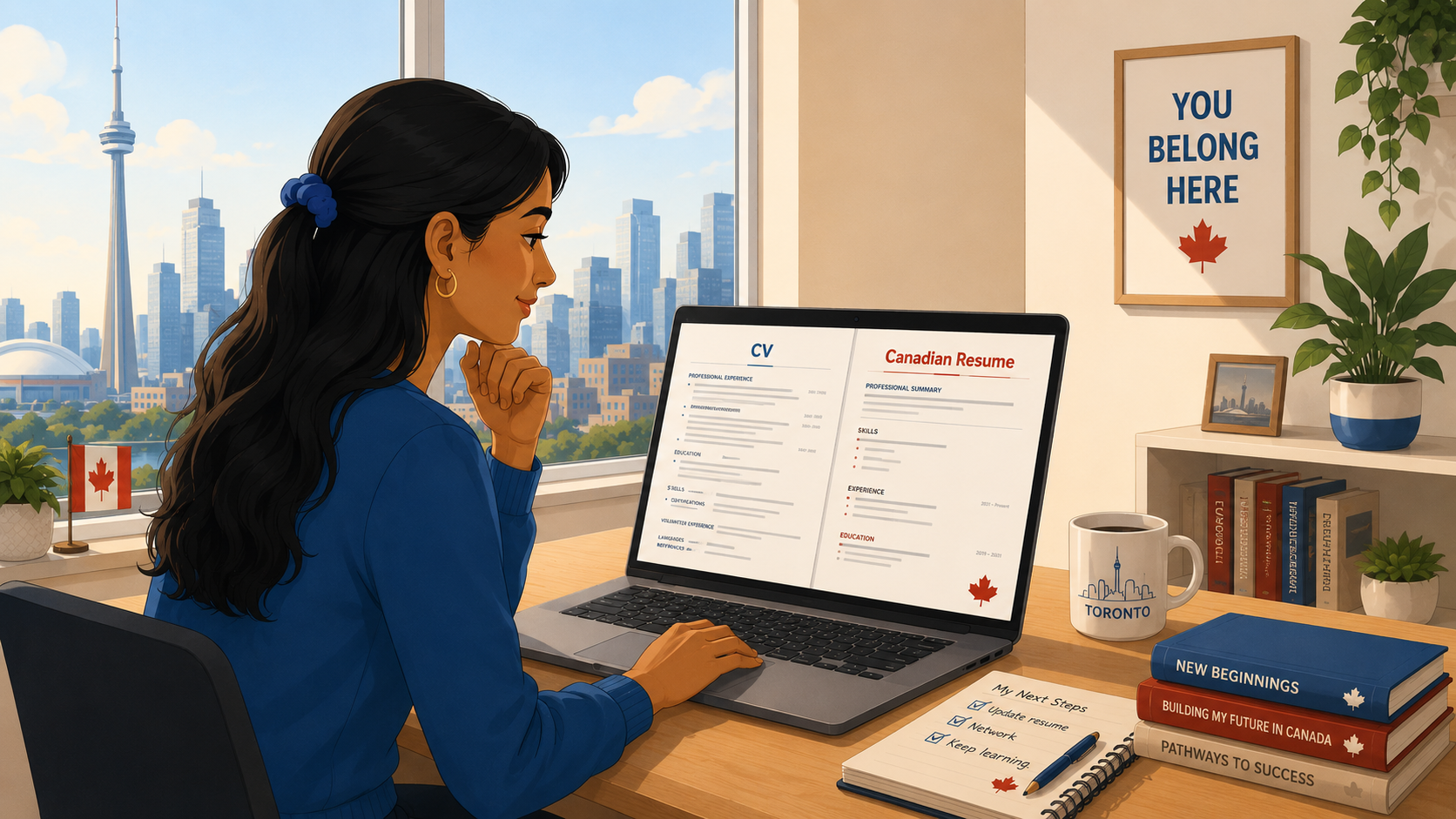
A Canadian resume is almost the opposite. It is short (one to two pages for most roles), tightly focused on the job you are applying for, and completely stripped of personal details that could invite discrimination. No photo. No age. No nationality. No marital status.
Canadian employers - especially in cities like Toronto, Vancouver, and Calgary - are trained to expect this format. When they see a four-page document with a headshot, it creates friction. And when an ATS parses a multi-column, image-heavy document, it often scrambles or drops critical information entirely.
That is the core reason conversion matters. It is not about dumbing down your experience. It is about translating it into a format that works in this market.
Why ATS Compatibility Is Non-Negotiable in Canada
Here is something worth understanding clearly: the ATS is not the enemy. It is a practical tool that companies use to manage high volumes of applications. The problem only comes when your resume cannot be read correctly by the software.
Most Canadian employers - any company of significant size in Toronto's financial sector, tech companies in Waterloo, healthcare networks across Ontario, government departments, large retailers - run incoming applications through an ATS before a recruiter ever opens a file. The system parses your resume, extracts data into searchable fields, and ranks you against other candidates based on keyword relevance.
If your resume is formatted with multi-column layouts, text boxes, decorative fonts, tables, or embedded graphics, the ATS will likely misread or skip entire sections. Your five years of project management experience might not register at all. Your contact information might end up in the wrong field.
This is not a minor inconvenience. It is the difference between getting an interview and getting ghosted.
Step 1: Strip the Personal Details That Do Not Belong in Canada
The first thing to remove from your CV is everything that would be completely normal in your home country but is considered unnecessary - or even problematic - in Canada.
Remove the following:
Your photo or headshot
Your date of birth or age
Your marital or family status
Your nationality or country of origin
Your SIN (Social Insurance Number) - never include this on a resume
Your religion or ethnicity
Your full home address (city and province is enough)
Canadian employment law is designed to prevent bias in hiring. Including these details does not help your application - it just creates legal and practical complications for the employer. Recruiters are trained to ignore them, and many will actually set aside a resume that includes them out of concern.
Keep your header clean: full name, phone number (with country code if applying from outside Canada), professional email, city and province, and your LinkedIn URL if it is updated.
Step 2: Shorten and Restructure Your Document
A common mistake newcomers make is submitting an eight-page CV and assuming Canadian employers will read all of it. They will not.
The standard in Canada is one page for recent graduates or career changers, and two pages for experienced professionals. Senior academic, research, or government roles may allow more, but even then, a traditional CV format is not the right approach unless specifically requested.
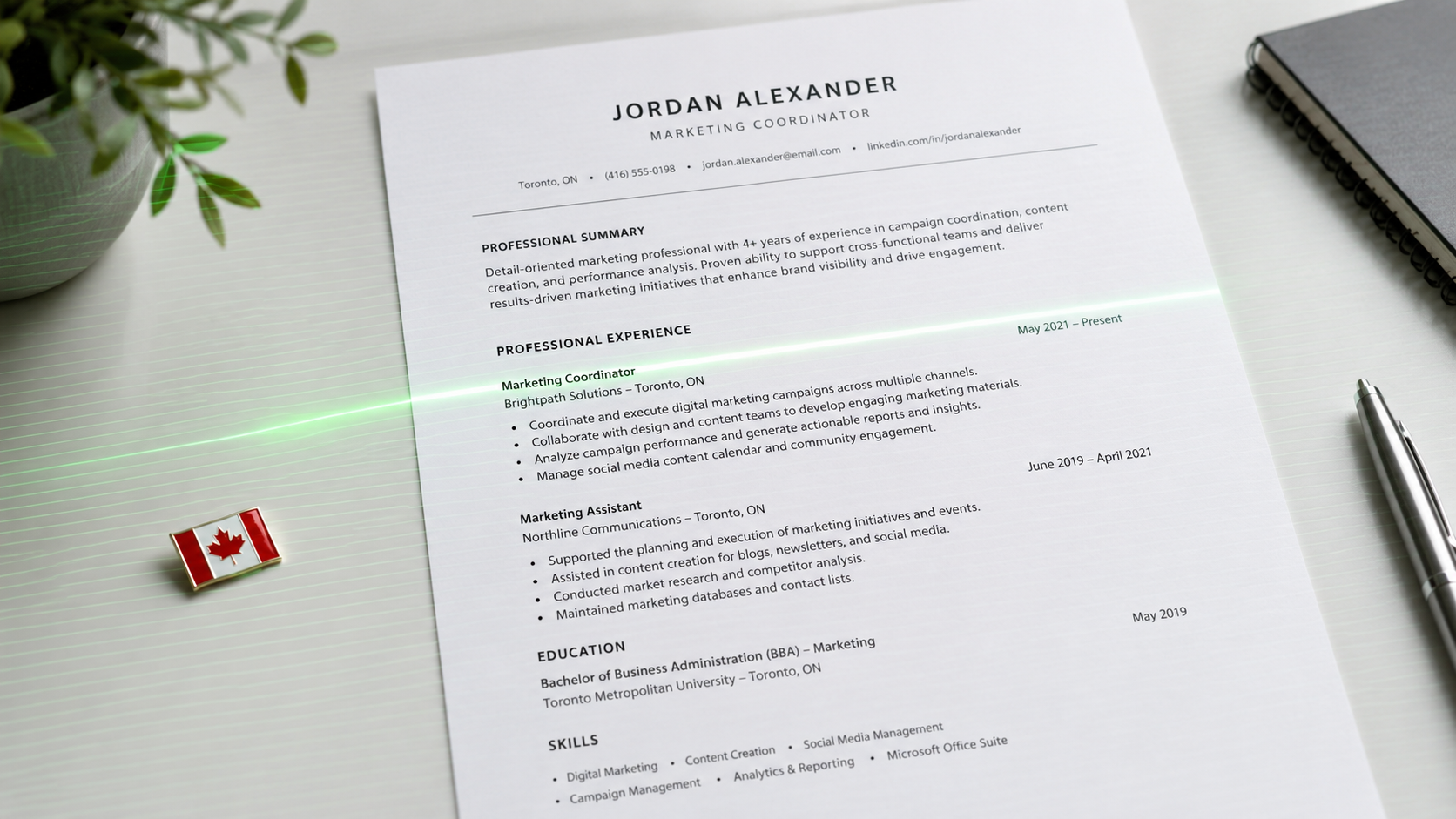
Here is the structure to follow for a strong Canadian resume:
Header (name and contact info)
Professional Summary (3 to 4 lines maximum)
Core Skills or Competencies (optional but ATS-helpful)
Work Experience (reverse chronological order)
Education
Certifications and Licences
Languages (if relevant)
Volunteer Work or Awards (optional)
That is it. If you have sections in your original CV that cover hobbies, references, personal interests, or a lengthy biographical narrative - cut them. References are provided when requested, not included on the resume itself.
Step 3: Reformat for ATS Readability
This is the step that most people underestimate. The visual presentation of your resume matters less than whether the ATS can actually parse it correctly. And many popular CV formats - especially those downloaded from design platforms - are visually beautiful but terrible for ATS systems.
Here are the formatting rules that matter most:
Use a single-column layout. Multi-column resumes confuse parsers, which read left to right, top to bottom. If your skills are in a left column and your job titles in a right column, the ATS might read them as one continuous scrambled string.
Avoid text boxes and tables. These are common in designed CVs but ATS software often cannot extract text inside them. Your accomplishments could simply disappear.
Use standard section headings. Titles like "Work Experience," "Education," and "Skills" are what ATS systems are programmed to recognize. Headings like "My Journey" or "What I Bring to the Table" might look creative but will confuse the parser.
Choose simple fonts. Arial, Calibri, Garamond, and Times New Roman are reliable choices. Stay between 10 and 12 points for body text, and 14 to 16 for headings.
Save your file correctly. A .docx file or a text-based PDF (not a scanned image PDF) are your safest options. If you are uploading to an online job portal, .docx typically parses most reliably.
Step 4: Adapt Your Language and Spelling to Canadian Standards
This one is easy to overlook, especially if you learned English in the United States or from American materials. Canada uses British English spelling, and Canadian recruiters notice when you do not.
Swap these:
"Color" becomes "colour"
"Analyze" becomes "analyse" (in most contexts)
"Organize" becomes "organise"
"Center" becomes "centre"
"Labor" becomes "labour"
"Defense" becomes "defence"
Also, if your CV mentions distances, weights, or measurements, convert them to metric. Write dates in a clear format - "January 2022" or "2022-01" works well, avoiding ambiguous formats like "01/03/22" which can be read differently across countries.
Use Canadian job titles and terminology where possible. If your role was called something unique to your region, research the equivalent Canadian title. This matters because recruiters search ATS databases using familiar terms.
Step 5: Quantify Accomplishments, Not Just Duties
One of the biggest differences between a CV and a strong Canadian resume is the shift from listing responsibilities to showcasing results.
A line like "Responsible for managing a team and overseeing client accounts" tells an employer nothing memorable. A line like "Led a team of 8 across three time zones, delivering a $2.3M infrastructure project 12% under budget" tells them everything.
Canadian employers and ATS algorithms both respond to numbers, outcomes, and specificity. Go through each role in your CV and ask: what did I actually achieve? Not just what did I do, but what changed because of my work? What did I improve, reduce, generate, build, or save?
If you are coming from an industry where outcomes are harder to quantify - teaching, healthcare, social services - focus on scope (number of students, patients, clients), improvements (test scores, recovery rates, satisfaction metrics), and recognition (awards, promotions, expanded responsibilities).
Step 6: Tailor Keywords to the Job Posting
Your resume is not a static document you send everywhere. Each application is an opportunity to calibrate the language of your resume to match the specific job posting.
Read the job description carefully and note the exact phrases used. If they say "cross-functional collaboration," use that phrase. If they list specific software, certifications, or methodologies, make sure yours are listed too (assuming you actually have them).
This is not dishonest - it is smart communication. ATS systems match your resume against the job description's keyword set. The closer your language mirrors theirs, the higher your ranking.
Some key practices:
Mirror the job title if it is reasonably accurate to your background
Include industry-specific terms relevant to Canadian practice
Use both spelled-out and acronym versions of certifications (for example, "Project Management Professional (PMP)")
Avoid stuffing keywords unnaturally - the human recruiter will eventually read it too
If you are not sure whether your resume is landing the right keywords, tools like CVMaple can run an instant ATS audit - flagging missing keywords, structural issues, and sections that Canadian recruiters expect to see. It is especially useful if you are not sure where your current document is falling short.
Step 7: Write a Strong Canadian-Style Professional Summary
Your professional summary is the first thing a recruiter reads after deciding your resume is worth a second look. It is not an "objective statement" explaining what you want from a company. It is a three to four line pitch explaining what you bring.
Think of it as your answer to: "Tell me about yourself" - but in professional writing, before any interview.
A strong summary for a newcomer might look like this:
"Results-driven civil engineer with 9 years of international project delivery experience across infrastructure and urban development. Adept at managing cross-functional teams, stakeholder communication, and compliance-driven timelines. Currently based in Toronto and available to contribute immediately."
Notice it establishes credibility, signals relevant skills, and grounds the candidate in the Canadian context. It does not mention where they are from, what visa they hold, or apologize for a lack of "Canadian experience."
Common Mistakes Newcomers Make When Converting Their CV
It is worth naming these explicitly because they are incredibly common.
Keeping the photo. Even if your LinkedIn has one, it does not belong on the resume itself in Canada.
Including a references section. This takes up valuable space and is not needed. "References available upon request" is also outdated. Just remove the section entirely.
Using a designed template with columns. These look sharp but fail ATS parsing. Choose function over aesthetics unless you are certain the employer is reviewing resumes manually.
Listing every job since university. Focus on the last 10 to 15 years of relevant experience. Earlier roles can be summarized in a line or dropped entirely.
Not tailoring. Sending the same version to 50 employers is a common trap. Even small adjustments per application significantly improve results.
Mistaking length for thoroughness. More pages do not signal more experience in Canada - they signal poor editing.
How CVMaple Makes the Conversion Process Easier
Converting a CV is a significant task, especially if you are doing it while also navigating the realities of arriving in a new country, completing credential recognition, or managing the demands of a study permit or PGWP.
CVMaple was built specifically for this situation. Using your existing CV or LinkedIn profile, it generates a properly structured Canadian resume in minutes - formatted for ATS, stripped of the elements that hurt you, and optimized for the types of roles being posted in the Canadian market. The AI resume audit tool will also score your current document and tell you exactly where it is losing points.
For newcomers who do not have time to spend weeks researching formatting rules, it removes a major friction point from the job search process.
A Note on the "Canadian Experience" Problem
One thing worth addressing honestly: even a perfectly formatted, ATS-optimized resume will not always overcome the informal barrier that many employers and recruiters put up around "Canadian experience."
This is a real phenomenon in cities like Toronto. It is also a form of systemic bias that many immigration advocates, government agencies, and employment organizations are actively working to address.
The best counter-strategy is not to hide your international background - it is to frame it confidently. Emphasize transferable skills. Seek out volunteer roles, contract work, or Canadian certifications that build local credibility. Use LinkedIn to connect with professionals in your target industry. And make sure your resume is doing everything it technically can to get past the ATS and into a human's hands, because that is where you can make the real case for yourself.
A strong, well-converted resume does not guarantee a job. But it eliminates a barrier that should not be in your way in the first place.
FAQ
Q: What is the biggest difference between a CV and a Canadian resume? A: A CV is typically a lengthy, detailed document covering your full professional and academic history - often including a photo and personal details. A Canadian resume is concise (one to two pages), focused on the job you are applying for, and never includes personal identifiers like your photo, age, or marital status.
Q: Do I really need to remove my photo from my resume to apply in Canada? A: Yes. Including a photo on a Canadian resume is considered unusual and can actually create discomfort for hiring managers who are trained to avoid any information that could introduce unconscious bias. Leave it off entirely.
Q: What file format should I use when submitting a resume for Canadian jobs? A: A .docx file or a text-based PDF are your safest choices for most online applications. Scanned image PDFs, heavily designed files, and formats like .pages or .odt can cause parsing problems with ATS software. If the job posting specifies a format, follow it.
Q: How do I make my international work experience relevant to Canadian employers? A: Focus on transferable accomplishments and quantify your results. Research the Canadian equivalent of your job titles. Use the same terminology found in Canadian job postings. Where possible, include any Canadian credentials, volunteer roles, or professional development that establishes local relevance.
Q: How many pages should my Canadian resume be? A: One page for recent graduates, entry-level applicants, or major career changers. Two pages for experienced professionals. Only government, academic, or senior executive roles typically warrant anything longer, and even then, they usually request a specific format.
Conclusion
Converting your CV is not a one-time task - it is the foundation of every job application you send in Canada. If your formatting is off, your keywords are wrong, or your structure does not match what ATS systems are designed to read, all the tailoring in the world will not help.
Canada AI Recruitment Market: How Artificial Intelligence Is Reshaping Hiring in 2026
CVMaple's AI-powered resume builder takes your existing experience and converts it into a properly structured, ATS-optimized Canadian resume in minutes. The Pro and Elite tiers unlock the full ATS audit tool, keyword scoring, cover letter generation, and a job application tracker - giving you a complete system rather than a single document. If you are serious about landing Canadian interviews faster, it is worth starting there: CVMaple
About the author
Mathew is an author at CVMaple, writing about ATS-friendly resume formats, AI in Canadian hiring, cover letters and converting a CV to the Canadian format.
Spotted something out of date? Tell us at support@cvmaple.ca.