Canadian Resume Tips 2026: How to Beat ATS and Get More Callbacks
Written by Catherin · Published · Updated
You sent out 40 applications. You heard back from two. And one of those was an auto-rejection.
If that sounds familiar, you are not imagining things. The Canadian job market in 2026 is not broken - but the way most people are submitting resumes is. The problem is not your experience, your skills, or even your work history. The problem is that your resume is likely being filtered out by software before a single human being ever lays eyes on it.
This is not a scare tactic. It is just how hiring works now, and understanding it changes everything about how you approach your job search.
What Is Happening When You Hit "Apply"
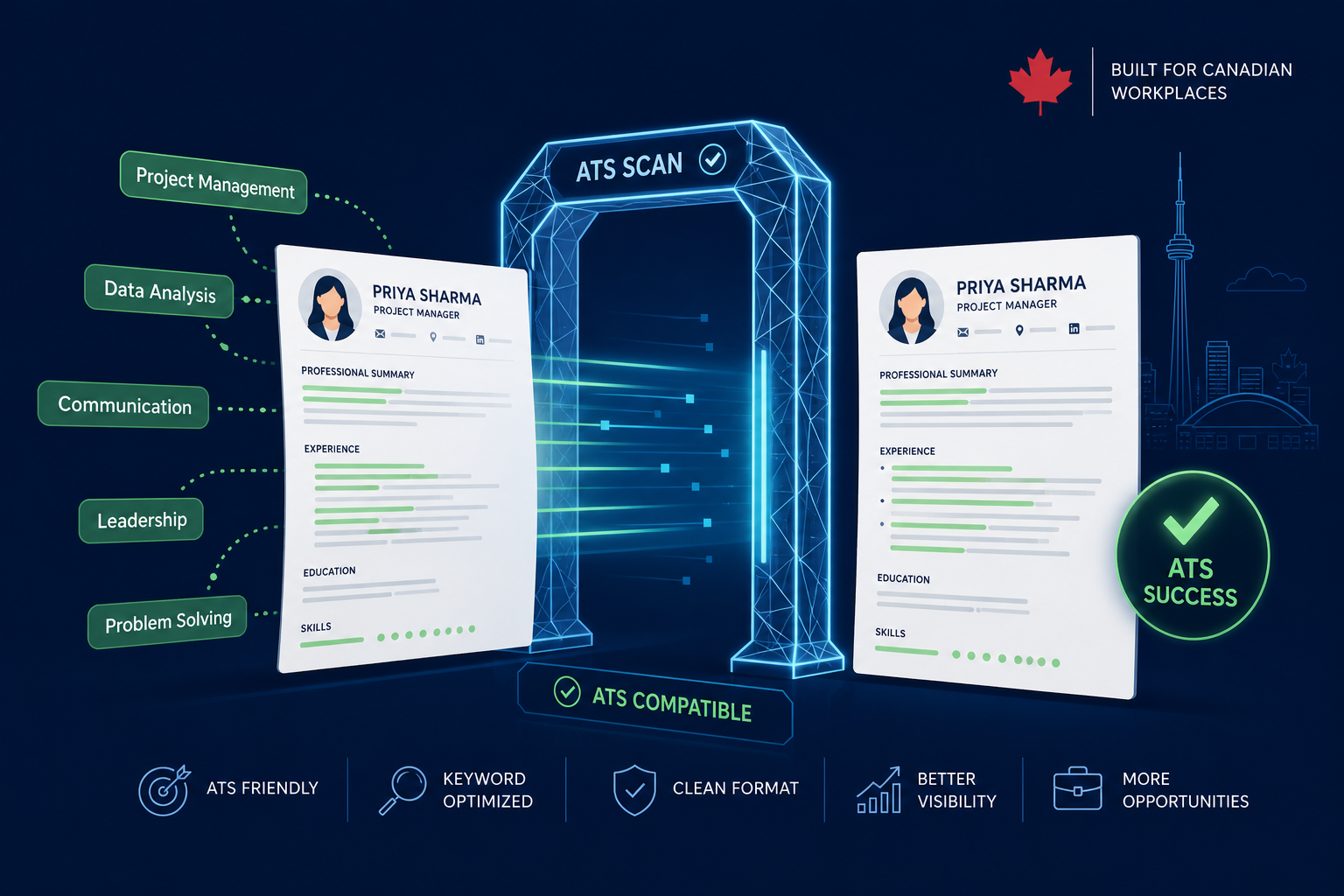
Most mid-to-large Canadian employers - think banks like RBC and TD, telecom companies, federal government departments, tech firms, hospitals, and major retailers - use software called an Applicant Tracking System, or ATS, to manage incoming applications.
When you upload your resume, the ATS does not hand it to a recruiter. First, it scans the document. It parses your text, extracts your job titles, dates, skills, and education, and stores all of it in a searchable database. Then it ranks you against other applicants based on how well your resume matches what the job description asked for.
If your resume does not format cleanly, or if it is missing the specific keywords the system is scanning for, your application score drops. Recruiters then search and sort that database - and candidates near the bottom rarely get looked at.
Over 70% of Canadian employers at the mid-to-large level now use ATS as a first filter. That is not a trend anymore. That is just how hiring works here.
The Five Most Common Reasons Your Resume Gets Filtered Out
Understanding the problem is half the fix. These are the five reasons resumes fail the ATS scan most often in Canada right now.
1. Your Formatting Is Too Creative
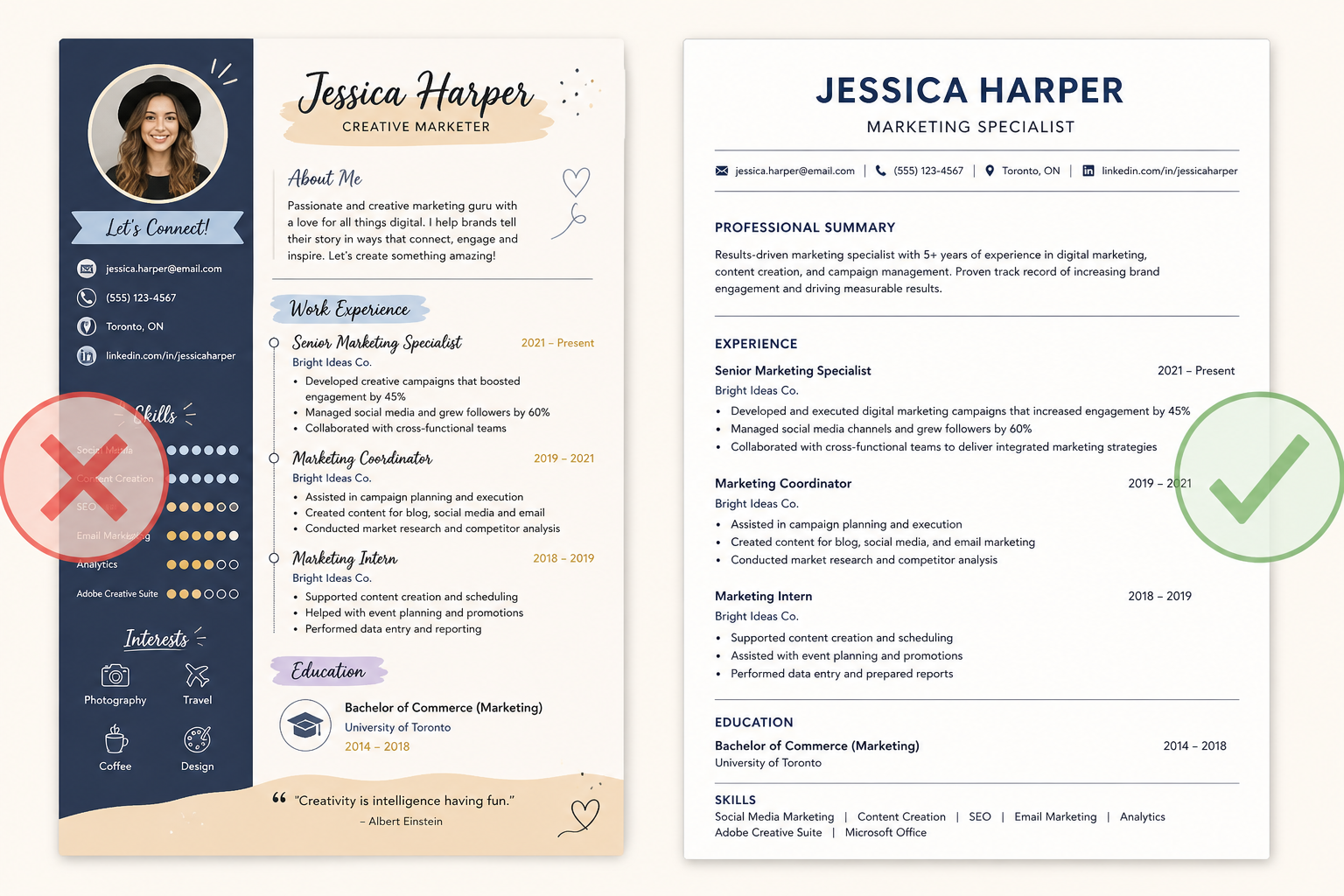
Multi-column layouts, text boxes, tables, icons, and fancy headers look great as a PDF on your screen. Inside an ATS, they are a disaster. The parser reads your resume left to right, top to bottom, as raw text. A two-column layout often gets read in the wrong order, garbling your job titles and dates. Text inside a table may not get extracted at all.
The fix is straightforward: use a single-column layout with clear, standard section headers like "Work Experience," "Education," and "Skills." That is it. Save the design for your portfolio.
2. You Are Missing the Right Keywords
ATS systems match your resume against the language in the job posting. Not themes. Not ideas. Actual phrases.
If a job posting says "stakeholder communication" and your resume says "client relations," the system may not connect the two - especially in older or simpler ATS platforms. The same applies to technical skills, software names, certifications, and job titles. You need to mirror the language the employer used, not your own preferred version of it.
Read every job posting carefully before you apply. Pull out the key skills and phrases. Then check your resume - are those words actually there?
3. Your Contact Info Is in the Header or Footer
This one trips up a surprising number of applicants. Many resume templates place your name, phone number, and email address in the document header. Visually, it looks clean. But many ATS platforms do not parse header and footer content - which means the system processes your resume with no name or contact information attached to it.
Put your name and contact details in the main body of the document, above the fold, just like plain text.
4. You Have Not Tailored the Resume at All
A generic resume sent to 50 different jobs is not an efficient strategy. It is actually the opposite. ATS systems score your resume against the specific job description for that role. A resume that scores 40% keyword match on a posting is very unlikely to be surfaced to a recruiter, no matter how qualified you actually are.
Tailoring does not mean rewriting your entire resume for every single application. It means adjusting your skills section, your summary, and two or three bullet points to reflect the language and priorities of each specific posting. That targeted approach raises your match score and your chances of being seen.
5. Your File Type or File Name Is Wrong
Submit a .docx or text-based PDF. Never submit a scanned image of a resume, a Pages file, or an image-heavy PDF created in Canva. These formats either fail to parse entirely or produce corrupted text.
Your file name also matters more than most people realise. "Resume_FINAL_v3_USE_THIS_ONE.pdf" is not the impression you want to make. Use your name and the role - something like "JanePark_MarketingCoordinator_Resume.pdf."
The Canadian-Specific Layer Most People Miss
Resume rules in Canada have some differences worth knowing, especially if you are a newcomer, a PGWP holder, or someone transitioning from another country's job market.
Canadian resumes do not include photos, your age, marital status, or your Social Insurance Number. Ever. Including these is not just unnecessary - it can actually flag your application as unfamiliar with Canadian norms, and some employers are legally advised to discard resumes that include protected information to avoid human rights liability.
Keep your resume to two pages maximum for most professional roles. Canadian hiring managers read a lot of resumes and appreciate conciseness. A third page is sometimes acceptable for very senior roles or academic positions, but it is not the norm.
For government of Canada roles specifically, the resume format is different from the private sector. You need to address the merit criteria in the job posting directly, often with much more detail than a typical corporate resume. Federal government ATS is also uniquely structured - generic resumes get eliminated very fast in federal hiring streams.
If you are applying while on a PGWP and your Canadian work history is limited, lead with your skills and any Canadian education, internships, or volunteer work. Address the "Canadian experience" gap directly rather than hoping the employer overlooks it.
What the 2026 Resume Actually Needs to Look Like
The rules have shifted. Here is what Canadian recruiters and their ATS systems are rewarding right now.
A value-focused summary, not an objective statement. Objective statements ("I am looking for a role where I can grow...") tell the employer what you want. A strong summary tells them what you bring. Three sentences. Lead with your title, your years of experience, and your clearest value. Done.
Bullet points that use metrics. Vague bullets are invisible. "Managed social media" means nothing. "Grew Instagram following from 2,000 to 18,000 over 14 months by building a weekly content calendar and running two paid campaigns" is something a hiring manager remembers. The formula is simple: action verb + what you did + how you did it + the result. Numbers do not have to be perfect. Approximations are fine. Just use them.
An AI skills or digital tools section. This is new but it matters. Job postings requiring AI competency have increased by nearly 10% year over year. If you use tools like ChatGPT, Notion AI, Copilot, or any automation software in your day-to-day work, list them. Not as a brag - just as evidence that you are current.
Semantic keywords, not keyword stuffing. ATS 2.0 systems (the newer generation) use semantic analysis. They understand context and meaning, not just exact matches. Write naturally. Use the terms from the job posting, but in real sentences, not crammed into a list at the bottom of your resume.
Where CVMaple Comes In
If you are sitting with a resume right now and wondering whether it would pass an ATS scan, there is no need to guess. CVMaple was built specifically for the Canadian job market and includes an ATS audit tool that flags the exact issues holding your resume back - missing keywords, formatting problems, sections that Canadian recruiters expect to see, and more.
It is not about handing your resume over to an AI and hoping for the best. The tool gives you the specific feedback, and you make the decisions. For newcomers, PGWP holders, and anyone who has been job searching in Canada for a while without much traction, the audit alone is often eye-opening.
CVMaple also lets you build from scratch using a one-click builder, import your LinkedIn profile as a PDF, and generate a tailored cover letter for each application. The free tier gets you started. The Pro and Elite plans unlock full ATS scoring and unlimited tailored versions - which is where the real value shows up when you are applying to multiple roles.
One More Thing: The Hidden Job Market Still Exists
All of this ATS advice matters for the jobs that are posted publicly. But it is worth knowing that a meaningful portion of Canadian jobs - estimates range widely, but it is significant - are filled through referrals, networking, and direct outreach before a posting ever goes live.
This is not an excuse to ignore your resume. It is a reminder that your resume is just one tool. LinkedIn profile, direct messages to hiring managers, attending industry events (even virtual ones), and reaching out to your existing network are all still valuable. In a competitive market, you want every channel working, not just the application portal.
That said, most people have to start with job boards. And if your resume cannot clear the first filter, none of the other effort matters. Get the foundation right first.
What to Do This Week
Here is a practical starting point. Pick one job posting you genuinely want to apply for. Read it carefully. Open your resume beside it. Ask yourself:
Do I have the top five keywords from this posting somewhere in my resume?
Is my resume in a single-column format with standard section headers?
Does every bullet point include a result, not just a task?
Is my contact info in the main body, not the header?
Have I removed any photos, age, or personal information that is not standard in Canada?
If the answer to any of those is no, fix it before you apply. A targeted, clean, ATS-optimised resume sent to 15 jobs will outperform a generic one sent to 100. Every time.
The Canadian job market is competitive right now, and the bar for getting noticed has genuinely risen. But the good news is that most people are still submitting resumes that fail on basic technical grounds. Fix the technical issues, tailor the language, add real metrics, and you immediately move ahead of a large portion of the applicants in the same pool.
That is a completely achievable advantage. You just have to know where to look.
FAQ
Q: Why is my resume not getting any responses in Canada?
A: The most common reason is ATS filtering. If your resume is not formatted cleanly, missing keywords from the job posting, or placed in a multi-column layout, the system may score it too low for a recruiter to ever see it. Run an ATS audit, tailor your resume to each posting, and make sure your formatting is single-column and text-based.
Q: Do Canadian employers really use ATS for every job?
A: Not every single employer, but the majority of mid-to-large companies do - including banks, hospitals, government departments, telecom companies, and most corporate employers. Smaller businesses and startups are less likely to use ATS, which is why networking and direct outreach can sometimes work better for those roles.
Q: What should a Canadian resume include in 2026?
A: A professional summary (not an objective statement), work experience with metric-driven bullet points, a skills section that includes digital tools and relevant software, and your education. Do not include a photo, your age, marital status, or SIN number. Keep it to two pages maximum for most roles.
Q: How do I make my resume pass ATS in Canada?
A: Use a single-column format, standard section headers, and a text-based PDF or Word document. Mirror the exact keywords and phrases from the job posting in your resume, especially in your skills section and bullet points. Avoid tables, text boxes, and creative layouts that break ATS parsing.
Q: What is the difference between a Canadian resume and a CV?
A: In Canada, the word "resume" and "CV" are often used interchangeably in professional contexts. However, a traditional academic or medical CV is longer and includes publications, research, and presentations. For most private-sector and government jobs in Canada, a two-page resume tailored to the specific role is what employers expect.
Conclusion
If you have been applying without much response, the issue is very likely fixable - and faster to fix than you might think. CVMaple's free ATS audit scans your resume against real Canadian job market criteria and tells you exactly what needs to change: missing keywords, formatting issues, sections Canadian recruiters expect, and more. It takes about two minutes and can change the outcome of every application you send after it.
Top 10 Resume Mistakes Newcomers Make in Canada (and How to Fix Them)
For job seekers who are actively applying - especially newcomers to Canada, PGWP holders, or anyone navigating a competitive market like Toronto or Vancouver - the Pro plan unlocks unlimited tailored resume versions and full ATS scoring. When you are sending out multiple applications a week, having a resume that is genuinely optimised for each posting is not a luxury. It is the difference between being in the running and being filtered out before anyone reads your name. Start free at https://cvmaple.ca and upgrade when you are ready.
About the author
Catherin is an author at CVMaple, writing guides on how to write a Canadian resume, resume tips, Express Entry resumes and job search sites in Canada.
Spotted something out of date? Tell us at support@cvmaple.ca.