Express Entry Resume: What to Include in 2026
Written by Catherin · Published · Updated
Express Entry Resume: Exactly What You Need to Include in 2026
You spent months preparing your Express Entry profile. Points calculated, language tests done, credentials assessed. You got your ITA. And now you are staring at your resume wondering if the document that got you jobs back home is actually going to work here.
It might not. And that is not a reflection of your experience or your qualifications. It is a formatting problem. A language problem. A "Canadian employers expect things a certain way and nobody told you" problem.
This guide covers exactly what your resume needs to include when you are job hunting as an Express Entry candidate in Canada, what to leave out, and the specific details that separate applications that get callbacks from ones that disappear quietly into an employer's inbox.
What Express Entry Has to Do With Your Resume
Express Entry itself is an immigration pathway - it determines how you get permanent residence, not how you get a job. But the two are closely connected in practice. Most Express Entry candidates arrive in Canada through the Federal Skilled Worker Program, the Canadian Experience Class, or the Federal Skilled Trades Program - all of which are built around the idea that you have real, transferable work experience that Canadian employers need.
The challenge is that your resume needs to communicate that value clearly and quickly to two very different audiences: the ATS software that most Canadian employers use to screen applications before a human sees them, and the recruiter or hiring manager who actually decides whether to call you.
Getting through both filters requires a specific approach. Here is what that looks like.
The Canadian Resume Format You Need

Before getting into the specific content, the format itself matters more than most people expect.
Canadian resumes do not include photos, date of birth, marital status, nationality, or social insurance numbers. If any of those are on your current resume, remove them before you send a single application. Many Canadian HR departments are trained to flag resumes that include personal characteristics that could influence hiring decisions, as employers have legal obligations under human rights legislation to evaluate candidates on merit alone.
The format that works best for Express Entry candidates is reverse chronological - most recent job first, working backwards through your career. One or two pages is the standard. If you have more than 15 years of relevant experience, two pages is reasonable. For most candidates, one focused, tight page performs better than two pages that include everything.
Use a clean, simple layout. No tables, no text boxes, no columns built inside tables, no graphics. The reason is practical: most Canadian employers run applications through Applicant Tracking Systems that parse resume content automatically, and complex formatting causes parsing errors that can get your application filtered out before anyone reads it.
What to Include in Every Section
Contact Information
Your name, Canadian city and province if you are already here (or your intended destination city if you are still abroad), a professional email address, your phone number, and your LinkedIn URL if your profile is current. That is all. Nothing else goes in the header.
If you are still outside Canada when applying, mention your expected arrival date or immigration status briefly in your professional summary - recruiters appreciate the transparency and it removes a common source of uncertainty on their end.
Professional Summary
This is the three to four sentence paragraph at the top of the page that tells a recruiter immediately who you are and what you bring. It is the highest-value real estate on your resume and most candidates either skip it or write something generic that adds nothing.
A strong professional summary for an Express Entry candidate should do four things: name your profession and years of experience, highlight your most relevant skill or achievement, mention your Canadian work eligibility or anticipated start date if relevant, and signal the type of role you are targeting.
Something like: "Civil engineer with 9 years of experience delivering infrastructure projects across South Asia and the Middle East. Proven record managing multi-million dollar project budgets and cross-functional teams of 15 or more. Arriving in Toronto in September 2026 as a permanent resident through Express Entry. Seeking roles in municipal infrastructure or construction project management."
That summary takes 15 seconds to read and tells a recruiter everything they need to know to keep going.
Core Skills Section
This is a short, scannable list of 8 to 12 skills placed just below your professional summary. Its primary purpose is ATS keyword matching. When a recruiter sets up a job posting in their system, the ATS scores incoming resumes based on how many of the listed qualifications appear in the document.
Pull the skills directly from job postings in your field. Use the exact terminology that Canadian employers use in your industry - not the equivalent from your home country, but the specific words and abbreviations that appear in Canadian postings. If the posting says "AutoCAD" and your resume says "computer-aided design software," you may not score the match.
Work Experience
List each role with your job title, the company name, the city and country, and your employment dates in month and year format. Then three to six bullet points per role describing your actual contributions.
This is where internationally trained professionals most often lose ground in the Canadian application process. The instinct in many countries is to list responsibilities - what your job required you to do. Canadian employers want to see achievements - what you actually did and what impact it had.
Start every bullet point with a past tense action verb. Managed, led, built, reduced, launched, negotiated, trained, implemented, redesigned, grew. Then add context and a number wherever you can.
"Responsible for managing customer relationships" is a responsibility. It says nothing about whether you were good at it.
"Managed relationships with 40 enterprise accounts, achieving 96% retention over two years" is an achievement. It tells a recruiter exactly what you did and gives them a benchmark.
You do not need precise statistics for every point. Estimates are fine. Ranges are fine. "Approximately 30% improvement" or "a team of 8 to 12 people" is better than leaving the number out entirely.
For roles held outside Canada, include them fully. Do not remove international experience or try to hide that you worked abroad. Canadian employers understand that skilled immigrants have careers that did not start here. What matters is whether the experience is relevant and whether it is presented clearly using terminology that Canadian hiring managers will recognise.
Education
List your degrees and diplomas in reverse chronological order. Include the institution name, the degree or credential, the location, and the year of graduation. If your credentials were issued outside Canada, you do not necessarily need a formal WES assessment for every application - but for regulated professions like engineering, accounting, nursing, or law, noting that a provincial licensing or credential recognition process is underway (or completed) is important context for the recruiter.
If you completed any Canadian education, training, or certifications after arriving - even short courses or professional development - list those as well. They demonstrate active integration into the local professional environment and help address the "Canadian experience" question directly.
The Keyword Problem and How to Fix It
Here is something that surprises a lot of Express Entry candidates: two people with identical qualifications can have very different callback rates based purely on word choice.
Canadian job postings are written with specific terminology in mind. ATS systems are configured to look for that same terminology. If your resume uses slightly different language - even synonymous language - it may score lower than a resume that mirrors the posting more closely.
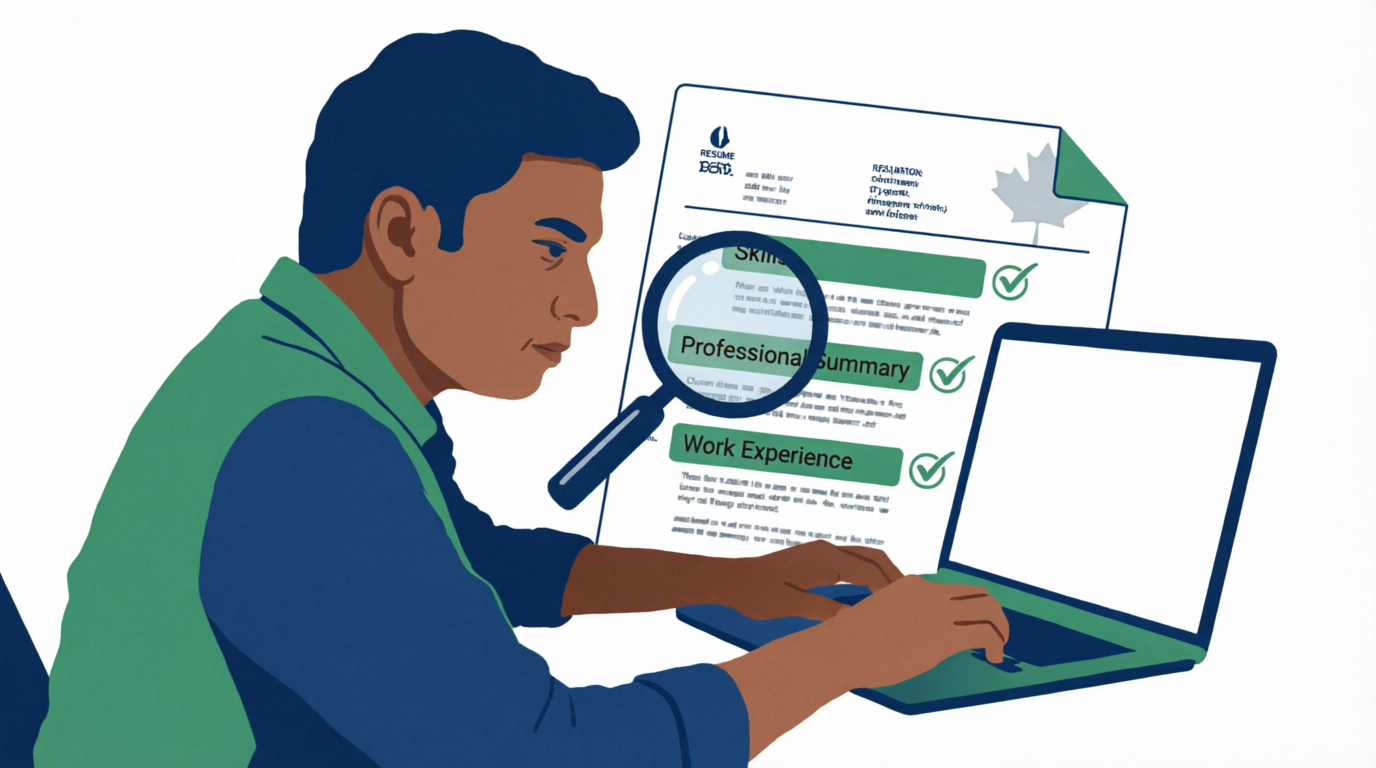
The practical fix is straightforward but requires effort. For every job you apply to, read the posting carefully and identify the specific skills, tools, certifications, and qualifications they have listed. Then check your resume to confirm that the exact terms appear somewhere in your document - in your skills section, your professional summary, or your experience bullet points.
This does not mean padding your resume with keywords that do not reflect your actual background. A recruiter will verify your claims in an interview. It means describing your genuine experience using the same language the Canadian employer uses, rather than the language you would have used at home.
If you want a faster way to do this, CVMaple's job post analyser lets you paste a job description and instantly see which keywords are present in your resume and which are missing. It takes about two minutes per application and removes most of the guesswork from the tailoring process.
Addressing the Canadian Experience Question
Almost every Express Entry candidate hits this wall at some point. You apply for a role, you are clearly qualified, and the response comes back asking about Canadian experience - or worse, no response comes back at all.
There is no perfect answer, but there are practical approaches that help.
The first is to actively build any form of Canadian professional touchpoint as quickly as possible after arriving. Volunteer work, industry association memberships, Canadian certifications, networking events - any of these can be referenced in your resume and demonstrate that you are already engaged in the local professional community.
The second is to target employers who actively recruit internationally trained professionals. Many Canadian industries - healthcare, engineering, construction, information technology, logistics - are dealing with genuine talent shortages and are far more open to international backgrounds than a generic job posting might suggest.
The third is to use your cover letter to address the question directly and confidently. Acknowledge that your experience was built abroad, explain briefly how it translates to the Canadian context, and point to specific achievements that demonstrate your capability. A one-paragraph bridge statement in a cover letter can pre-empt the concern before it becomes a reason not to call you.
A Note on Government of Canada Applications
If you are targeting federal public service roles - which many Express Entry candidates do, given the job security and benefits - the application process is different from the private sector.
Federal applications through the Government of Canada Jobs portal require you to demonstrate in writing how you meet each listed qualification. A standard resume is often not sufficient on its own. You will typically need to complete a full application with narrative responses explaining your relevant experience for each criterion.
CVMaple has a dedicated Government of Canada resume builder (https://cvmaple.ca) that formats your experience specifically for federal applications - a different structure than what works in the private sector, and one that most generic resume tools do not support.
FAQ
Q: Does my immigration status need to be on my Canadian resume? A: You do not need to include your immigration status on your resume. However, many hiring managers do want to know whether you are currently eligible to work in Canada. A brief, confident note in your professional summary - "Permanent resident available to start immediately" or "Currently completing Express Entry process, anticipated arrival March 2026" - can remove uncertainty and prevent unnecessary screening out. Keep it to one line and put it in the summary, not in the header.
Q: Should I include all my international work experience on a Canadian resume? A: Yes, include it - but be selective about how far back you go. The standard Canadian approach is to focus on the last 10 to 15 years of experience. Earlier roles can be summarised briefly or omitted if they are no longer directly relevant. For each international role you do include, use terminology that Canadian employers in your field will recognise, and lead with achievements and outcomes rather than responsibilities.
Q: Do I need a WES assessment to apply for jobs in Canada through Express Entry? A: A WES (World Education Services) assessment was likely already part of your Express Entry application for immigration purposes. For job applications, a formal credential assessment is required for regulated professions - engineering, nursing, medicine, law, and accounting all require provincial licensing. For non-regulated roles, most employers will simply verify your qualifications during the hiring process. Having a WES report does not hurt, but it is not universally required for private sector job applications.
Q: How do I explain an employment gap on a Canadian resume? A: Be straightforward about it. If you had a gap due to your immigration process, family responsibilities, or job searching after arrival, a brief honest note is better than trying to hide or rearrange your timeline. Many Canadian employers understand that immigration transitions take time. You can address it directly in your professional summary - "Currently resettling in Canada following 9 years in project management in the UAE" - or briefly in a cover letter. What Canadian recruiters flag is unexplained gaps, not gaps that are acknowledged honestly.
Q: Is a two-page resume acceptable for Express Entry candidates with extensive experience? A: Yes, if the experience genuinely warrants it. The Canadian standard is one to two pages, with two pages acceptable for candidates with more than 10 to 15 years of directly relevant experience. The key test is whether every item on the second page adds value for the specific role you are applying to. If you find yourself including older, less relevant roles just to fill the space, cut them. A tighter one-page resume almost always outperforms a padded two-page one.
Conclusion
Tailoring a resume for every Canadian application takes time - especially when you are also navigating a new city, a new system, and a job market that works differently from what you are used to.
CVMaple was built specifically for this transition. The AI resume builder knows Canadian formatting standards, the ATS checker flags missing keywords before you apply, and the job post analyser shows you exactly which terms from a posting are absent from your current resume. If you are targeting federal roles, the Government of Canada resume builder formats your experience for the public service application process specifically - which most tools do not support at all. Start free at https://cvmaple.ca and run a check on your current resume before your next application goes out.
About the author
Catherin is an author at CVMaple, writing guides on how to write a Canadian resume, resume tips, Express Entry resumes and job search sites in Canada.
Spotted something out of date? Tell us at support@cvmaple.ca.