How to Write a Canadian Resume in 2026 | Complete Guide
Written by Catherin · Published · Updated
How to Write a Canadian Resume in 2026: A Complete Guide for Job Seekers
Writing a resume for Canada is not the same as writing a resume for other countries. Canadian employers want something clear, concise, and easy to scan, with the right keywords, a simple format, and a strong focus on achievements. If you are applying for jobs in Canada, your resume needs to do more than list your experience. It needs to match how recruiters and ATS systems review applications.
In this guide, you will learn how to write a Canadian resume step by step, what to include, what to avoid, and how to make your resume stronger for Canadian employers. Whether you are a newcomer, international student, permanent resident, recent graduate, or experienced professional, this article will help you build a resume that fits Canadian expectations.
What Is a Canadian Resume?
A Canadian resume is a job application document that presents your skills, work experience, education, and achievements in a format Canadian employers expect. It is usually clean, professional, and tailored to the job you are applying for. The goal is not to look flashy. The goal is to make your qualifications easy to understand quickly.
In Canada, most employers prefer a reverse chronological format, which means your most recent job appears first. They also value relevance, clarity, and a strong match between your resume and the job posting. A Canadian resume should not be overloaded with personal details, unnecessary graphics, or long paragraphs.
Canadian Resume Format
The standard Canadian resume format is simple and structured. It usually includes these sections in this order:
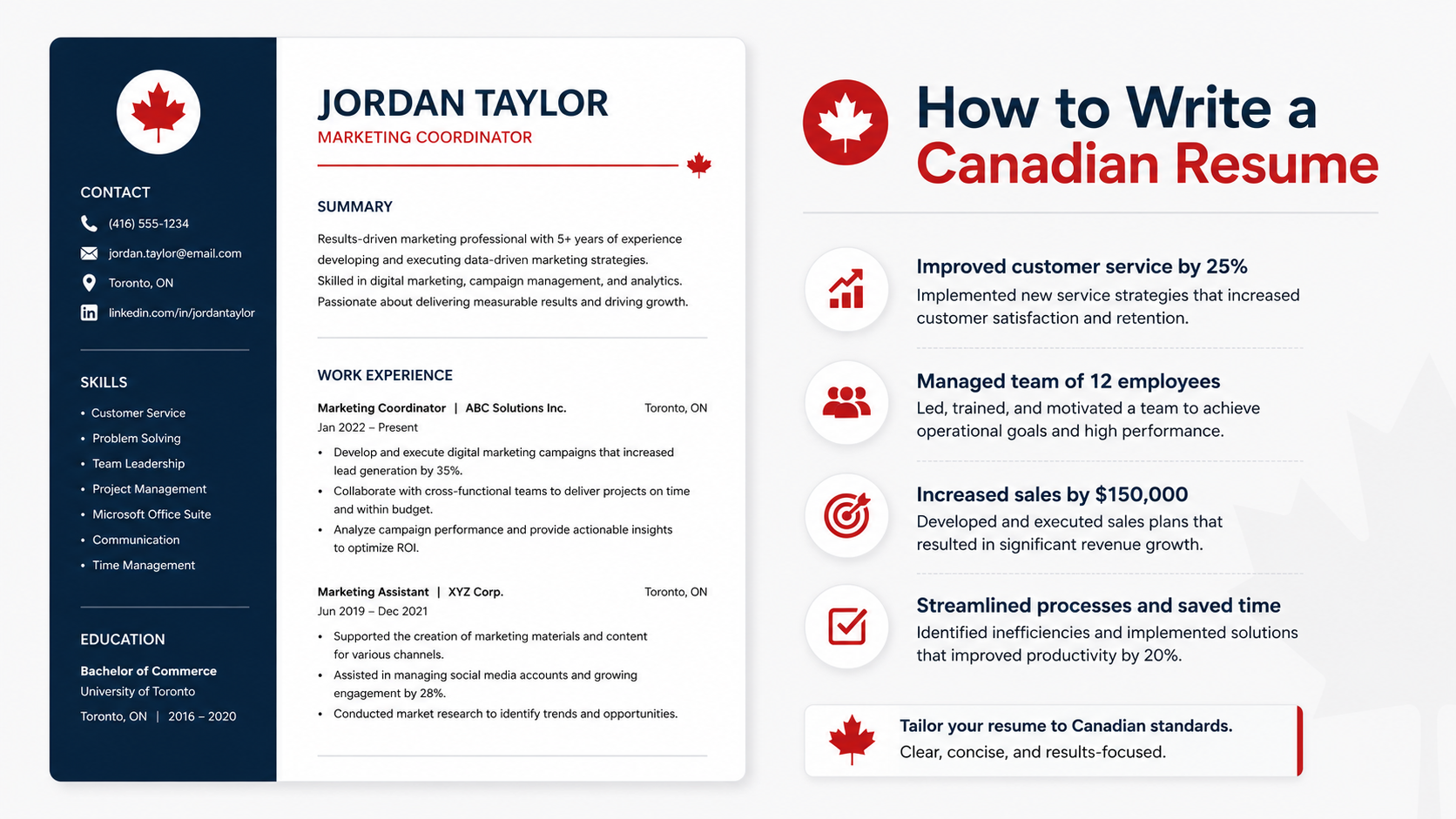
Contact information
Professional summary
Skills
Work experience
Education
Certifications or training
Volunteer experience, if relevant
For most jobs, a one-page resume is enough for entry-level candidates, students, and newcomers. Experienced professionals can often use two pages if the content is relevant and focused. The key is to keep it concise and make every line count.
Canadian employers want a resume that is easy to scan. Use clean fonts, simple headings, consistent spacing, and bullet points for your accomplishments. Avoid unnecessary design elements that can make the resume harder to read or less ATS-friendly.
Contact Information
Your contact information should be at the top of your resume. This section should include your full name, phone number, email address, city or province, and optionally a LinkedIn profile or portfolio if it is relevant to the job.
Do not include personal details like age, marital status, religion, SIN number, or photo. These are not needed on a Canadian resume and can create problems. Make sure your email address looks professional. If your current email is informal, create a new one using your name.
A strong contact section might look like this:
John Smith Toronto, ON 416-555-1234 johnsmith@email.com linkedin.com/in/johnsmith
Professional Summary
Your professional summary is a short paragraph at the top of your resume that explains who you are, what you do, and what value you bring. This section should be two to four sentences long. It should be tailored to the job you want, not copied and pasted across every application.
A good summary highlights your years of experience, key skills, industry background, and the type of role you are targeting. If you are a newcomer or recent graduate, focus on transferable skills, education, internships, volunteer work, or previous experience that relates to the role.
Example:
Results-driven customer service professional with 4 years of experience supporting clients in fast-paced environments. Skilled in communication, conflict resolution, and CRM systems. Seeking a customer support role where strong problem-solving and relationship-building skills can support business growth.
Skills Section
The skills section helps recruiters quickly see whether you match the job requirements. It should include both hard skills and relevant soft skills. Hard skills are tools, systems, methods, and technical abilities. Soft skills are qualities like communication, teamwork, leadership, and adaptability.
Do not list random skills just to fill space. Focus on skills that appear in the job description and make sense for the role. If the job post mentions Excel, data analysis, customer service, project coordination, or bilingual communication, and you genuinely have those skills, include them.
Examples of useful skills:
Microsoft Excel
Project coordination
Customer support
Data entry
Sales reporting
Team leadership
Time management
Bilingual communication
CRM tools
ATS resume optimization
Work Experience
Your work experience is one of the most important parts of your Canadian resume. List your jobs in reverse chronological order, starting with your most recent role. For each position, include the job title, company name, location, and dates of employment.
Under each role, use bullet points to describe what you accomplished, not just what you were responsible for. Employers want to see results. Try to include numbers where possible. Quantifying your impact makes your resume much stronger.
Weak example:
Responsible for customer service and data entry.
Better example:
Assisted more than 40 customers per day and maintained a 98 percent accuracy rate in data entry.
Use action verbs like led, improved, built, supported, managed, created, reduced, increased, and developed. Keep each bullet point short, direct, and relevant.
How to Write Strong Bullet Points
Many resumes fail because the bullet points are too vague. Instead of listing duties, focus on outcomes. A strong bullet point usually follows this pattern:
Action verb + task + result
Examples:
Improved customer response time by 25 percent by reorganizing the support workflow.
Managed weekly scheduling for a team of 12 employees across two shifts.
Increased sales by 18 percent through targeted follow-up and account support.
Created monthly reports that helped leadership make faster hiring decisions.
If you are a newcomer or recent graduate, you can use internships, volunteer work, school projects, and part-time jobs to show relevant skills. Canadian employers value experience that demonstrates your ability to contribute, even if it was not a full-time career role.
Education Section
Your education section should include your highest degree or diploma first. List the school name, program or credential, location, and graduation year. If you are a recent graduate, you can also include relevant coursework, academic projects, or honors.
If your education was completed outside Canada, you can still include it clearly. If it helps the employer understand your background, you may also mention credential evaluation if you have one. For newcomers, education can be a major strength, especially when paired with transferable skills and related experience.
Example: Bachelor of Business Administration York University, Toronto, ON 2021
Certifications and Training
If you have certifications that matter for the role, include them in a separate section. This is especially useful for technical, healthcare, finance, admin, trades, and IT roles. List the certification name, issuing organization, and date if relevant.
Examples:
Google Data Analytics Certificate
First Aid and CPR
WHMIS Certification
Project Management Professional
Adobe Certified Professional
Only include certifications that are relevant. Do not clutter your resume with training that does not support the job you want.
Volunteer Experience
Volunteer work can be very valuable on a Canadian resume, especially for newcomers, students, and career changers. If the volunteer experience shows leadership, communication, teamwork, organization, or industry-related skills, include it.
This section is especially useful when you do not have much Canadian work experience yet. It helps employers see how you contribute in real situations.
Example: Volunteer Coordinator Local Community Centre, Toronto, ON 2023 to 2024
Organized weekly volunteer schedules for 20 participants.
Supported event planning and community outreach campaigns.
Improved attendance at monthly events through better coordination and follow-up.
What to Leave Out
A Canadian resume should be focused and professional. Do not include unnecessary or outdated information. Leave out:
Age or date of birth.
Marital status.
Religion.
SIN number.
A photo.
Long paragraphs.
Full mailing address unless needed.
Irrelevant jobs from too far back.
Generic statements with no proof.
You should also avoid using fancy graphics, tables, icons, or unusual formatting if you are applying through an ATS. Simple and readable is usually better.
Canadian Resume Length
The ideal resume length depends on your experience. For most job seekers, one to two pages is best. If you are a student or newcomer, one page may be enough. If you have several years of relevant experience, two pages is acceptable.
The most important thing is relevance. If something does not help you get the job, cut it. Canadian employers care more about quality than length.
ATS and Canadian Resumes
Many companies in Canada use ATS, or applicant tracking systems, to scan resumes before a human sees them. That means your resume needs to be easy for software to read. Use standard section titles, simple formatting, and keywords from the job posting.
Here are a few ATS-friendly tips:
Use clear headings like Work Experience and Education.
Avoid text boxes and heavy design layouts.
Use the same job title language from the posting where appropriate.
Include relevant keywords naturally.
Save as PDF only if the employer allows it and the file keeps formatting intact.
If your resume is visually attractive but hard to scan, it may not perform well. A Canadian resume should look professional, but it should also be readable by machines.
Tailoring Your Resume
One of the best ways to improve your chances in Canada is to tailor your resume for each job. This means adjusting your summary, skills, and bullet points to match the job posting. You do not need to rewrite everything, but you should make the most relevant parts stand out.
A strong process looks like this:
Read the job posting carefully.
Highlight repeated keywords and required skills.
Match your summary to the role.
Reorder your experience bullets to show the most relevant work first.
Adjust your skills section to reflect the posting.
This simple step can make a huge difference because it helps you align your resume with what the employer is already looking for.
Resume Tips for Newcomers to Canada
If you are new to Canada, your biggest challenge is often not experience. It is making your experience understandable in a Canadian context. Focus on translating your background into clear, local language. Use Canadian spelling, Canadian job titles where appropriate, and North American terms that match the market.
You should also emphasize transferable skills, volunteer work, internships, and any Canadian education or training you have completed. If your previous job titles are uncommon in Canada, add a short clarification so employers understand what you did.
Example: Operations Executive, similar to Office Manager responsibilities
That kind of clarity can help recruiters interpret your background correctly.
Top 10 Resume Mistakes Newcomers Make in Canada (and How to Fix Them)
Resume Tips for International Students and PGWP Holders
International students and PGWP holders often have strong potential but limited full-time work experience. That is not a problem if you position your background correctly. Highlight internships, part-time jobs, campus leadership, projects, volunteer roles, and technical skills.
If you studied in Canada, place that education near the top of your resume. Employers often care about local education, communication skills, and familiarity with the work environment. Make sure your resume shows that you can contribute in a Canadian workplace.
Resume Tips for Bilingual and Quebec Roles
If you are applying to bilingual roles or jobs in Quebec, your resume may need to be in French or include French language skills. Some employers expect a professional French CV, not just a translated English resume. That means the language should feel natural and polished.
If you are bilingual, mention your language abilities clearly in the skills or separate language section. Be honest about your proficiency level. If you are converting your resume to French, make sure the wording fits Canadian French usage, not just direct translation.
Common Resume Mistakes
Many job seekers make the same mistakes over and over. Avoid these if you want better results:
Using one generic resume for every job.
Writing long paragraphs instead of bullet points.
Listing duties without results.
Ignoring keywords from the posting.
Using a complicated design.
Including too much personal information.
Making spelling or grammar errors.
Forgetting to proofread the final version.
Even a small mistake can reduce your chances. A clean, tailored, error-free resume always performs better than a crowded one.
Canadian Resume Tips 2026: How to Beat ATS and Get More Callbacks
Canadian Resume Example Structure
Here is a simple structure you can follow:
Your Name City, Province Phone number Email address LinkedIn profile
Professional Summary Two to four sentences summarizing your background and target role.
Skills List 6 to 10 relevant skills.
Work Experience Job Title Company Name, Location Dates Bullet points with achievements
Education Degree, School, Location, Year
Certifications Certification name, issuer, year
Volunteer Experience Role, Organization, Location, Dates Bullet points if relevant
Final Checklist Before You Apply
Before sending your resume, check these items:
Is the resume tailored to the job?
Are the most important keywords included naturally?
Is the format clean and easy to read?
Are the bullet points focused on achievements?
Is the resume no more than two pages?
Are spelling and grammar correct?
Does the file open correctly and keep formatting?
Does the resume match Canadian expectations?
If you can answer yes to most of these, your resume is in strong shape.
Build a Better Canadian Resume Faster
Writing a Canadian resume does not have to take hours. The right format, the right keywords, and the right structure can help you build a stronger application much faster. The goal is to make your value obvious, easy to scan, and relevant to the role you want.
If you want to improve your resume quickly, CVMaple helps Canadian job seekers build ATS-friendly resumes, match job keywords, check resume scores, and export polished PDFs designed for the Canadian job market.
FAQs
What is the standard format for a Canadian resume?
The standard Canadian resume follows a reverse chronological format with clear sections: contact information, professional summary, skills, work experience, education, certifications, and volunteer experience. It should be clean, simple, and easy to scan.
How long should a Canadian resume be?
For most people, one to two pages is best. Students, newcomers, and entry-level candidates often need one page. Experienced professionals can use two pages if the content is relevant.
What should I include in my professional summary?
Your professional summary should mention your years of experience, key skills, industry background, and the role you are targeting. It should be short, focused, and tailored to the job.
Should I include a photo on my Canadian resume?
No. Photos are not standard on Canadian resumes. Including one can create privacy issues or bias.
Do Canadian resumes need to be in French?
Most Canadian resumes are in English. If you are applying to Quebec or bilingual roles, you may need a French version or your resume may need to show bilingual skills.
Do I need to address my Canadian resume to a specific person?
No. Canadian resumes are not addressed to anyone. You only include your contact information at the top.
What is the most important part of a resume in Canada?
Your work experience and achievements are the most important. Employers want to see results, not just duties.
How do I make my resume ATS-friendly in Canada?
Use clear headings, simple formatting, standard fonts, and keywords from the job posting. Avoid text boxes, graphics, and unusual layouts.
Can I use one resume for every job in Canada?
No. You should tailor your resume for each job by adjusting your summary, skills, and bullet points to match the job posting.
What should I do if I have no Canadian work experience?
Focus on transferable skills, volunteer work, internships, and any Canadian education or training. Canadian employers value experience that shows you can contribute even if it was not a full-time career role.
About the author
Catherin is an author at CVMaple, writing guides on how to write a Canadian resume, resume tips, Express Entry resumes and job search sites in Canada.
Spotted something out of date? Tell us at support@cvmaple.ca.