How to Translate Foreign Job Titles and Credentials on a Canadian Resume (With Before and After Examples)
Written by Dipin A. · Published · Updated
Translate Foreign Job Titles and Credentials on a Canadian Resume (With Before and After Examples)
You held a senior title back home. Maybe you managed a team of twenty people, or you were a licensed professional with a decade of trusted experience. Then you moved to Canada, sent out fifty resumes in your first month, and heard back from almost nobody.
If that sounds familiar, the problem usually is not your experience. It is that your resume is still speaking a language Canadian recruiters and applicant tracking systems were never trained to read.
Quick answer: to translate foreign job titles and credentials for a Canadian resume, find the closest Canadian National Occupational Classification (NOC) title for your role, get your education assessed by a recognized body like WES, and rewrite your bullet points using Canadian terminology, metric measurements, and quantified results. The goal is not to exaggerate your background. It is to make a Canadian hiring manager understand it in the first ten seconds.
Let's get into exactly how to do that.
How to Tailor Your Resume to a Job Posting in Canada (2026 Guide That Actually Works)
Why Foreign Job Titles Get Lost in Translation
Job titles are not standardized across countries, and that is the root of most of this confusion. A "Deputy General Manager" in India, a "Sales Officer" in the Philippines, or a "Head of Department" in Nigeria can all describe responsibilities that map cleanly onto a Canadian "Operations Manager" or "Account Manager." But a Canadian recruiter scanning a resume for ten seconds, or an ATS scanning it in milliseconds, has no way to know that. They are matching against the keywords and titles they expect to see, not researching your country's corporate hierarchy.
This is not a small detail. Most mid-to-large Canadian employers run resumes through an ATS before a human ever opens the file. If your title and keywords do not match what the system is looking for, your resume can be filtered out automatically, regardless of how qualified you actually are.
The same problem applies to credentials. A degree, designation, or certification that carries real weight in your home country can look unfamiliar or unverifiable to a Canadian employer who has no frame of reference for it.
The Real Cost of Leaving Your Experience Untranslated
Here is what makes this particularly frustrating for newcomers: you almost never get told why you were rejected. There is no email that says "we did not recognize your job title" or "we were not sure your degree was equivalent." Your application just disappears into the same silence as every other one that did not make it past screening.
That silence is doing a lot of damage to a lot of strong candidates. Many newcomers assume the issue is a lack of "Canadian experience," and while that gap is real and worth addressing separately, it is often compounded by a resume that simply was not written in a way Canadian systems and recruiters could parse.
The good news is that this is one of the most fixable problems in the entire job search process. You are not changing your experience. You are changing how it is presented.
Step 1: Find the Canadian Equivalent of Your Job Title
Start with the National Occupational Classification (NOC) system, which is what Canadian employers, immigration programs, and Job Bank all use to categorize roles. Searching your closest NOC code on the Government of Canada's Job Bank site will show you the standard title and a list of common job duties associated with it in the Canadian context.
From there, cross-reference with real job postings. Search Indeed Canada or LinkedIn for the role you are targeting and see what titles and language Canadian employers in that field are actually using right now. This matters because titles drift over time and by industry, and the goal is to mirror current Canadian usage, not a textbook definition.
A few real examples of how this translation can look:
"Deputy General Manager, Operations" (India) becomes "Operations Manager"
"Sales Officer" (Philippines, banking sector) becomes "Relationship Manager, Retail Banking"
"Lead, Customer Delight" (a title common at some South Asian outsourcing firms) becomes "Customer Success Lead" or "Customer Experience Manager"
"Articled Assistant" at a chartered accountancy firm becomes "Audit Associate" or "Accounting Trainee," depending on the actual duties performed
Notice that none of these examples inflate the role. They translate it. If your foreign title genuinely involved more seniority than the Canadian equivalent suggests, you can preserve that nuance in your professional summary or a bullet point, rather than in the title line itself.
Step 2: Get Your Credentials Properly Assessed and Listed
If you are applying to a regulated profession, or you simply want your degree to carry full weight with Canadian employers, an Educational Credential Assessment (ECA) is worth doing. World Education Services (WES) is the most widely recognized provider and is commonly used for Express Entry applications as well as general employer verification. Alberta has its own IQAS program, and British Columbia uses ICES, so the right body can depend on your province.
Once you have an assessment, list it directly in your education section rather than leaving your degree to stand alone. For example:
Before: "Bachelor of Engineering, Anna University, Chennai, India, 2017"
After: "Bachelor of Engineering, Anna University, India, 2017 (WES ECA: equivalent to Canadian Bachelor's Degree)"
This single addition does a lot of work. It tells a Canadian hiring manager, in their own frame of reference, exactly what your degree means, without requiring them to do any research of their own.
Step 3: Rewrite Your Bullet Points in Canadian Business Language
This is where most of the actual transformation happens, and it goes beyond swapping out a job title. Canadian resumes favour short, results-driven bullet points with quantified outcomes, metric units, and action verbs at the start of each line. Many resumes from other countries lean more heavily on duty lists and formal, hierarchical language.
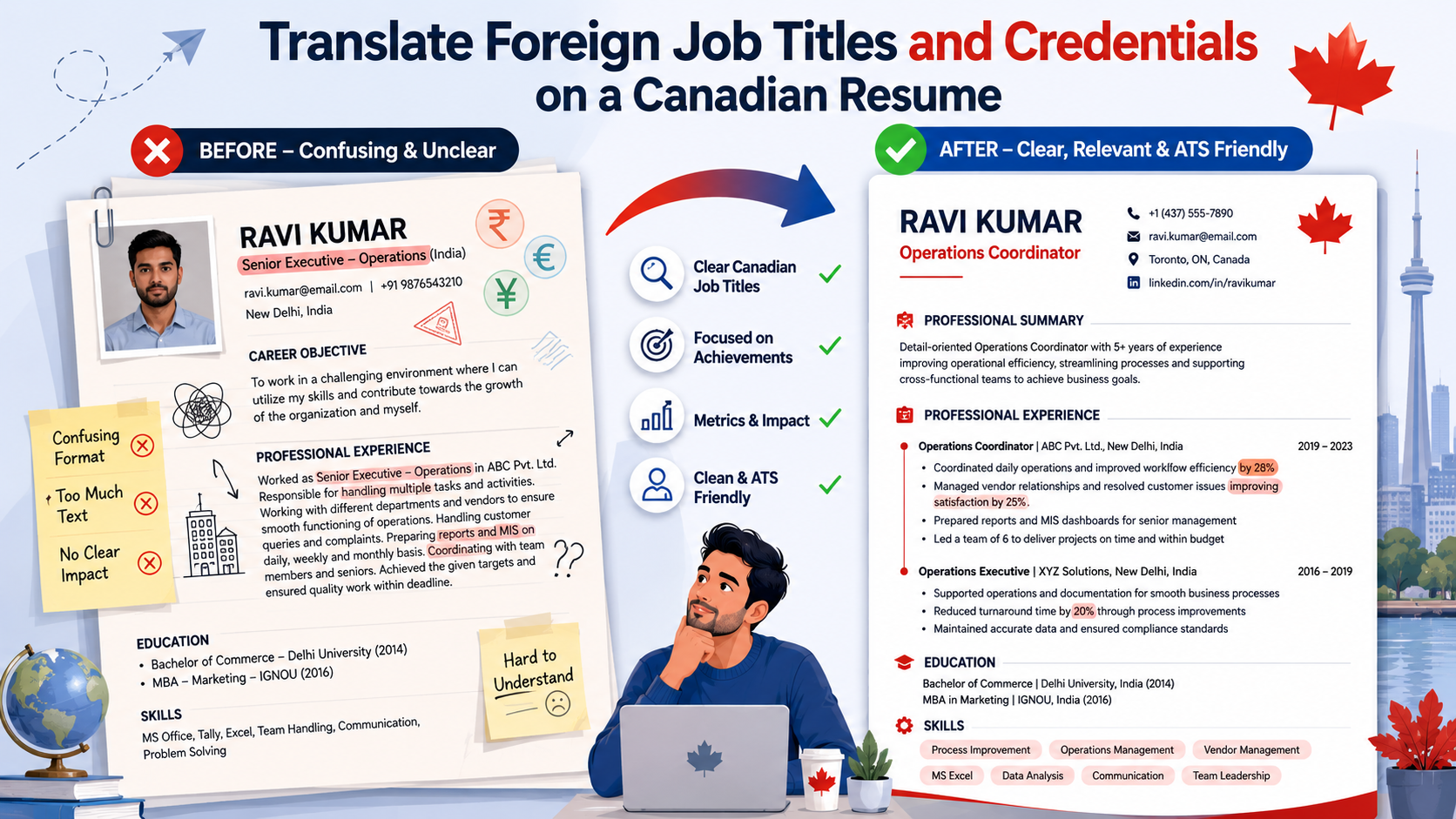
Here is a side-by-side comparison:
Before: "Responsible for overseeing daily operations of the branch and ensuring smooth functioning of all departments under my supervision, including liaising with senior management on a regular basis."
After: "Managed daily operations across four departments, improving turnaround time on customer requests by 18 percent and reporting key performance metrics directly to senior leadership."
Before: "Handled the accounts of various clients and made sure that all financial transactions were completed properly as per company policy."
After: "Managed a portfolio of 35 client accounts, processing over 500 transactions monthly with a 99.6 percent accuracy rate while ensuring full compliance with internal financial controls."
A few smaller fixes that make a real difference: convert any currency references into a percentage or relative figure rather than a foreign currency amount that means little to a Canadian reader, switch distances and weights to metric if your original resume used imperial units, and use Canadian date formatting (Month Year, such as "June 2022") rather than day-first formats common elsewhere.
If you are not sure whether your resume is hitting these marks, tools like CVMaple (https://cvmaple.ca) can run an instant audit that flags untranslated job titles, missing Canadian keywords, and formatting that does not match what local ATS systems expect.
Step 4: Handle Regulated Professions With Extra Care
Some professions in Canada are regulated by law, meaning you legally cannot use certain titles or perform certain duties until you are licensed in the province where you intend to work. Engineering, nursing, accounting, teaching, and several trades all fall into this category.
If this applies to you, do not list your foreign designation as though it were already Canadian-equivalent. Instead, be specific and honest about where you stand in the process. A few examples:
"P.Eng licence application in progress with Professional Engineers Ontario (PEO)"
"Internationally Educated Nurse, currently completing NCLEX-RN preparation"
"Chartered Accountant (India), pursuing CPA Canada designation"
This phrasing actually works in your favour. It shows the employer you understand the Canadian regulatory landscape and are actively navigating it, rather than glossing over a requirement they will eventually ask about anyway.
Common Mistakes That Get These Resumes Rejected
A few patterns show up again and again in resumes from newcomers, and most of them are easy to fix once you know to look for them.
Listing your former company's size or market ranking without context is one. "Worked at one of the top 5 companies in [home country]" means very little to a Canadian recruiter who has no benchmark for that ranking system. Reframe it around scale instead, such as employee count, revenue range, or client base, using terms that translate universally.
Keeping a foreign job title untranslated is another big one, especially for titles that sound senior in one country but do not map cleanly elsewhere, like "Manager Trainee" or "Executive Officer." Translate first, then add nuance in your summary if needed.
Omitting your credential equivalency entirely is a missed opportunity, since it is one of the easiest and fastest trust signals you can add to a resume.
Mixing date formats, currency symbols, or measurement units throughout the document creates small, repeated friction points that add up. A resume should read as though it was written for a Canadian employer from the first line to the last.
And finally, not stating language proficiency clearly. If English or French is not your first language but you are fluent, say so with a recognized score if you have one, such as IELTS or TEF. Canadian recruiters often assume fluency only when it is explicitly stated, especially for bilingual roles in Quebec or federal positions.
Top 10 Resume Mistakes Newcomers Make in Canada (and How to Fix Them)
Putting It All Together: A Quick Resume Snippet
Here is what this translation looks like applied to a full entry, not just isolated lines.
Before: Deputy Manager, ABC Technologies Pvt Ltd, Bangalore, India (2018 to 2022) Responsible for team handling, client coordination, and ensuring all project deliverables were completed within deadlines as per client requirements.
After: Project Manager, ABC Technologies, India (2018 to 2022) Led a team of 8 developers delivering software projects for international clients, maintaining a 95 percent on-time delivery rate across 22 completed projects and improving client retention by 30 percent over two years.
The second version is not longer or more complicated. It is simply translated into the language Canadian recruiters and ATS systems are already scanning for.
How AI Tools Can Speed This Process Up
Doing this manually for an entire resume, role by role, takes real time, and most newcomers are trying to fit a job search around settling into a new country, finding housing, and adjusting to a new system all at once. This is exactly the kind of repetitive, detail-heavy work that AI resume tools were built to help with.
CVMaple's one-click builder was designed with this exact situation in mind: newcomers who have strong experience but are not sure how to frame it for Canadian employers. You can paste in a job description alongside your current resume content, and the tool will suggest Canadian-equivalent phrasing, flag titles or terms that may not translate well, and help you quantify achievements that you might currently be describing only in duty-list form. Combined with the LinkedIn PDF import feature, it becomes a much faster way to get from "resume that worked back home" to "resume that gets interviews in Canada."
None of this replaces your judgment. You know your own experience better than any tool does. But having a second set of eyes trained specifically on Canadian resume conventions can catch the small mismatches that are easy to miss when you are deep in your own career history.
Where to Go From Here
Translating your foreign job titles and credentials is not about hiding where you came from or downplaying your background. Canadian employers increasingly value international experience and the perspective it brings. The goal is simply to remove the unnecessary friction that stops a qualified application from ever reaching a human being.
Start with one resume, one role at a time. Find the Canadian equivalent title, get your credentials assessed if it makes sense for your field, rewrite your strongest achievements with metrics and Canadian terminology, and be upfront about where you stand on licensing if your profession requires it. Small, consistent changes here tend to produce results faster than most people expect.
FAQ
Q: Do I need to remove my foreign job title from my Canadian resume entirely? A: No. You should translate it to its closest Canadian equivalent rather than removing it. You can still mention your original title in your professional summary or a bullet point if it adds useful context about your seniority.
Q: What is a WES credential assessment and do I actually need one? A: WES, or World Education Services, evaluates foreign degrees and tells Canadian employers and institutions what your education is equivalent to in the Canadian system. It is not legally required for most jobs, but it is strongly recommended, especially for Express Entry applications and any role where your education needs to be verified.
Q: How do I find the Canadian equivalent of my foreign job title? A: Search the National Occupational Classification (NOC) system on Job Bank for your closest role, then compare current job postings on Indeed Canada or LinkedIn to see how Canadian employers in your field are titling similar positions right now.
Q: Should I mention my former company's size or ranking in my home country? A: Only if you reframe it in terms a Canadian recruiter can understand, such as employee count or revenue range. A ranking or reputation that is well known locally usually means nothing to someone unfamiliar with that market.
Q: What if my profession is regulated in Canada, like engineering or nursing? A: Be specific and honest about where you stand in the licensing process rather than implying you already hold the Canadian designation. Phrases like "P.Eng licence application in progress" or "pursuing CPA Canada designation" are accurate and show employers you understand the requirements.
Q: Can AI resume tools actually translate foreign experience automatically? A: They can get you most of the way there by suggesting Canadian-equivalent titles and phrasing and flagging terms that may not translate well, but you should always review the suggestions against your own experience to make sure nothing is lost or overstated in translation.
Conclusion
If you are staring at a resume full of titles and achievements that made sense back home but feel out of place here, you do not have to untangle it line by line on your own. CVMaple's AI audit was built to catch exactly this kind of mismatch, flagging job titles, formatting, and keywords that Canadian ATS systems and recruiters are not recognizing, and suggesting clearer alternatives.
If you are on the free plan and finding this kind of detailed feedback useful, upgrading to Pro or Elite unlocks deeper resume scoring, unlimited tailored rewrites for each job application, and cover letter generation that carries the same Canadian framing through your entire application. Think of it less as a subscription and more as an investment in the resume that actually gets opened.
About the author
Dipin A. is an author at CVMaple, writing about Canadian resume format and length, resume keywords, PGWP and entry-level resumes, and foreign credentials.
Spotted something out of date? Tell us at support@cvmaple.ca.