How to Tailor Your Resume to a Job Posting in Canada (2026 Guide That Actually Works)
Written by Madina · Published · Updated
Learn how to tailor your resume to any Canadian job posting in 2026. Step-by-step guide
You spend an hour finding the perfect job posting. You hit submit. Then nothing. Not even an automated "we will be in touch."
This silence is the most frustrating part of the Canadian job market right now, and it almost always comes back to one thing: your resume was not tailored to the job.
Sending the same resume to every posting is the most common mistake Canadian job seekers make. It feels efficient. It is actually the slowest route to an interview, because most applications never reach a human. Around 80 percent of resumes get filtered by Applicant Tracking Systems (ATS) before a recruiter sees them, and the resumes that survive that filter are the ones that mirror the language of the job posting itself.
Best ATS-Friendly Resume Format in 2026: Canadian Job Seekers Guide
This guide walks through exactly how to tailor a resume to a Canadian job posting in 2026. No vague advice. No "use keywords" without telling you which ones. Just the process Toronto, Vancouver, and Calgary recruiters quietly tell their friends to use.
Why Tailoring Your Resume Matters More in Canada Than You Think
Canada's job market in 2026 is more competitive than it has been in nearly a decade. Unemployment has been hovering near 6 to 7 percent, and employers are receiving record numbers of applications per posting. A mid-level marketing role in Toronto can pull 300 to 600 applications within 48 hours of going live.
When volume is that high, recruiters do not "read" resumes. They scan them. And before they even scan them, software does. Most Canadian banks, including RBC, TD, BMO, and Scotiabank, use ATS platforms like Workday or Taleo. Tech companies like Shopify, government departments, and most hospitals also rely on ATS to filter applicants.
This double filter, machine first then human, is the reason a generic resume cannot win anymore. The ATS rejects it for missing keywords. The recruiter skips it because nothing on the page connects directly to the role on their screen.
Canadian Applicant Tracking System (ATS): How It Works and How to Get Past It
Tailoring is not about rewriting your resume from scratch. It is about adjusting roughly 15 to 25 percent of it so the right parts catch the right eyes.
What Tailoring a Resume Actually Means
Tailoring a resume means rewriting your professional summary, reordering your skills, and adjusting your bullet points so that the most relevant experience matches the priorities of the specific job posting in front of you.
It does not mean:
Lying about your experience
Inventing skills you do not have
Stuffing keywords until your resume reads like a robot wrote it
It does mean:
Mirroring the exact phrasing the employer uses
Moving relevant achievements higher up the page
Cutting or shrinking content that does not support this specific role
Tailoring is editorial work, not creative writing. You already have the raw material. You are choosing what to spotlight.
Step 1: Decode the Job Posting Like a Recruiter Would
Before you touch your resume, read the job posting three times. Not skim. Read.
On the first pass, just read it normally to get a feel for the role and the company tone.
On the second pass, mark every "must have" and "nice to have" qualification. These usually sit under "Requirements" or "Qualifications." Pay close attention to what is repeated. If "stakeholder management" appears in the summary, the responsibilities, and the qualifications, that is a top-three priority for the hiring manager.
On the third pass, look at language patterns. Does the company say "drive results" or "deliver outcomes"? Do they describe their team as "fast-paced" or "collaborative"? Do they use "client" or "customer"? These small word choices reveal company culture and the kind of candidate they picture in the role.
How to Write a Canadian Resume in 2026 | Complete Guide
Then visit the company website. Read their About page. Skim a few recent posts on their LinkedIn. You are looking for the words they use when describing themselves, because those are the words that will land when echoed back in your resume.
Step 2: Build a Keyword Map Using the 30 Percent Rule
This is the step most people skip, and it is the one that quietly decides whether the ATS lets you through.
Open a blank document. Copy the job posting into it. Now extract every:
Technical skill (Python, Tableau, Salesforce, AutoCAD)
Tool or platform (Jira, HubSpot, SAP)
Certification (PMP, CPA, Red Seal, RN)
Soft skill (stakeholder management, cross-functional collaboration)
Job title or role-related noun (project manager, account executive, registered nurse)
Action verb that describes the work (led, designed, implemented, optimized)
Sort them into two columns: required and preferred.
Now apply the 30 percent rule. If you scan three or four similar postings in the same role and a keyword shows up in at least 30 percent of them, that keyword belongs on your resume. This protects you from over-tailoring to one quirky posting that uses unusual language.
For Canadian roles in 2026, ATS platforms increasingly use semantic matching, which means they recognize related terms. "Project management" and "Agile project management" can both register. But the safest play is still to use the exact phrasing of the posting when the skill is one of their top priorities. If the posting says "Agile project management," put "Agile project management" on your resume, not just "project management."
Step 3: Rewrite Your Professional Summary for This One Role
Your professional summary is the first thing both ATS and recruiters scan. It is also the easiest section to tailor.
A good Canadian professional summary in 2026 is three to four sentences. It contains:
Your years of experience and core function (matched to the job title in the posting)
Two or three of the most important skills from the posting
One quantified accomplishment that proves you can do the work
A subtle nod to what the employer is looking for
Here is the difference in practice.
Generic summary: "Experienced marketing professional with a track record of driving growth and managing campaigns across multiple channels."
Tailored summary for a B2B SaaS demand generation role at a Toronto tech company: "B2B demand generation marketer with 6 years scaling pipeline at Canadian SaaS companies. Built and optimized HubSpot and Salesforce-integrated funnels that generated $4.2M in attributed revenue across paid search, content, and ABM. Strongest in startup environments where speed and analytics matter equally."
Notice the tailored version uses words that almost certainly appear in the job posting (B2B, demand generation, HubSpot, Salesforce, ABM, pipeline) without sounding stuffed. It quantifies. It signals fit with the company stage.
You do not need to rewrite this from scratch every time. Build one master summary, then swap out three or four phrases per application.
Step 4: Reshape Your Work Experience Without Lying
Your work history stays factually the same across every application. What changes is the emphasis.
For each role, look at your bullet points and ask: does this support the story I am telling for this specific job?
If yes, keep it and consider strengthening the language to mirror the posting.
If no, either shrink it or remove it.
Here is the principle. If you are applying to a senior data analyst role, your bullet point about "redesigned the onboarding deck for new hires" is probably not earning its place on the page. Cut it or replace it with a more analytics-focused achievement from the same role.
You should also reorder bullets within each job. The most relevant achievement should be the first bullet under each position. Recruiters spend an average of six to eight seconds on a resume in the first pass. The top bullet of each job is the one they actually read.
Action verbs matter more than they get credit for. Canadian recruiters notice the difference between "responsible for managing a team of five" and "led a team of five marketers, delivering 18 percent year-over-year revenue growth." The second has ownership, scale, and outcome. The first is forgettable.
Step 5: Reorder Your Skills Section to Match the Posting
The skills section is the most aggressively keyword-scanned part of any resume. It is also the easiest to tailor in under three minutes.
A few rules that work in Canada:
List hard skills first, soft skills last
Lead with the skills the posting names in its top five requirements
Use both the acronym and the full term for the major ones: "Search Engine Optimization (SEO)" or "Project Management Professional (PMP)"
Do not list a skill you cannot confidently discuss in an interview
A skills section is not a wishlist. It is a promise. If your resume claims "advanced Python" and you cannot write a list comprehension, the interview will end quickly.
Canadian Resume Format: 2026 Guide for Newcomers in Canada
For technical roles, group your skills into clear subcategories. Languages, frameworks, cloud platforms, databases, tools. ATS parses these subgroups cleanly, and recruiters appreciate the visual organization.
Step 6: Quantify Everything That Can Be Quantified
If there is one habit that separates the resumes that get Canadian interviews from the ones that do not, it is quantification.
Canadian employers value measurable impact. Vague achievements like "improved team performance" or "worked closely with stakeholders" carry almost no weight. Numbers turn the same content into evidence.
Some quantification angles to consider:
Percentage change: "Reduced customer churn by 23 percent in two quarters"
Dollar value: "Closed $1.8M in new business in 12 months"
Volume: "Triaged 80+ patient charts per shift across two units"
Time: "Cut monthly close from 8 days to 3"
Scale: "Managed a portfolio of 14 enterprise accounts"
If you genuinely do not have the number, estimate conservatively and label it as such. "Roughly tripled" or "more than doubled" is honest if you do not have an exact figure.
This works because ATS systems in 2026 increasingly use AI scoring that weights quantified achievements higher, and because human recruiters mentally rank candidates by tangible impact. A resume with five quantified bullets beats a resume with twenty unquantified ones almost every time.
Step 7: Pass the ATS Without Sounding Like a Robot
This is where most tailoring advice falls apart. People stuff keywords until their resume reads like a tag cloud, then wonder why no human ever calls.
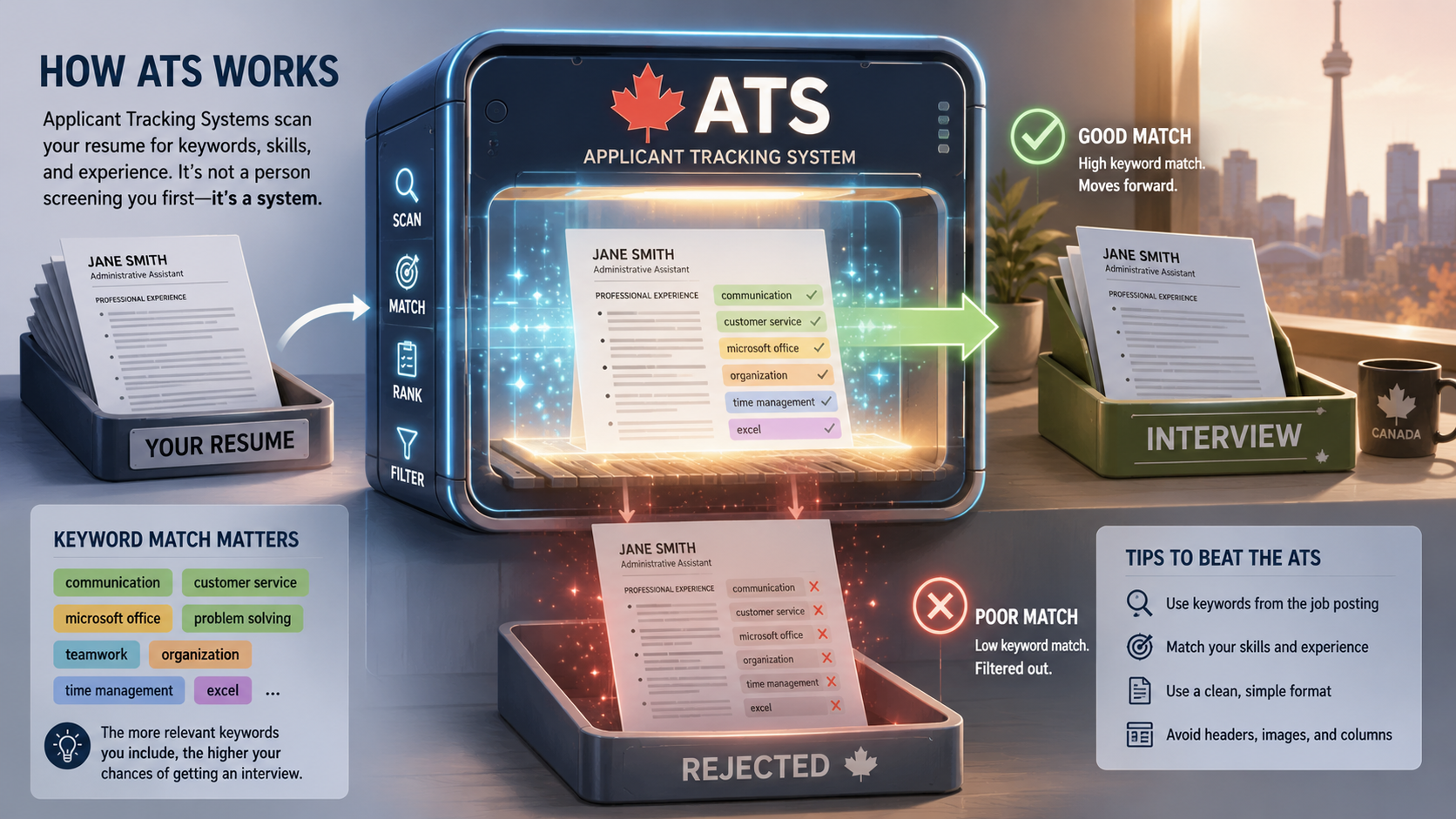
The trick is to embed keywords inside achievement statements. Do not list "Agile project management" as a standalone phrase. Write it like this:
"Led a cross-functional team of 7 using Agile project management practices, shipping 12 product releases over 18 months and reducing average sprint slippage by 40 percent."
That bullet hits "Agile project management," "cross-functional," "product releases," and quantified impact. The ATS reads it as keyword-rich. The recruiter reads it as a competent person describing real work.
A few practical ATS rules for Canadian applications in 2026:
Use a single-column layout. Two-column resumes look modern but break in older parsing engines.
Use standard section headings: Professional Summary, Work Experience, Skills, Education. Cute headings like "My Journey" confuse the parser.
Submit as PDF unless the posting specifically asks for .docx. Most modern Canadian ATS handle PDF fine.
Stick to standard fonts: Calibri, Arial, Helvetica, Times New Roman.
Use month and year for all dates. "January 2022 - March 2024" parses better than "01/22 - 03/24."
Do not put contact information in headers or footers. Many parsers skip those regions entirely.
If you are not sure whether your resume is ATS-ready, tools like CVMaple Resume Check can run an instant audit, flagging missing keywords, parsing risks, and formatting issues that Canadian recruiters typically expect to see addressed.
Common Mistakes Canadian Job Seekers Make When Tailoring
A few patterns show up over and over in the resumes that never get callbacks.
Tailoring only the cover letter. The cover letter matters, but the resume is what gets parsed first. Tailor the resume first, then write a cover letter that builds on it.
Copying job posting language word for word into bullet points. Recruiters read hundreds of postings a week. They notice. Mirror the keywords, but in the context of your own real achievements.
Removing experience that "is not relevant." Sometimes a career changer cuts entire jobs to make a resume look more focused. This usually backfires. Canadian recruiters value the full picture. You can shrink a role to two lines without removing it entirely.
Ignoring Canadian credential equivalency. If you trained outside Canada, run your credentials through World Education Services (WES) or another designated organization, and add the equivalency directly on your resume. This single line removes hesitation for newcomers competing against Canadian-educated candidates.
Forgetting Canadian spelling. Favour, not favor. Centre, not center. Labour, not labor. Recruiters who read 200 resumes a day notice the wrong spelling within two seconds, and the mismatch quietly signals "not local."
Using a photo, age, or marital status. Canadian human rights legislation makes these a no for employers, and most recruiters will toss a resume that includes them, both to reduce unconscious bias and to keep their company compliant.
How to Tailor Faster Without Cutting Corners
Tailoring takes 20 to 40 minutes per application if you do it from scratch every time. That is not sustainable for someone sending 30 applications a month.
The smarter system:
Build one strong master resume that contains every meaningful achievement from your career
Build a parallel "keyword bank" document with the top 20 to 30 phrases from postings in your target role
For each application, duplicate the master, cut what does not fit, swap in the right keywords from the bank, and rewrite the summary in five minutes
With practice, tailored applications take 10 to 15 minutes each. That is the sweet spot. Long enough to actually customize. Short enough to apply to several roles in a single sitting.
CVMaple's one-click builder was designed with this exact problem in mind. Paste the job description into the tool, and it generates a tailored draft with a rewritten summary, prioritized skills, and reordered bullets that you can refine in minutes instead of hours.
A Quick Word on Tailoring for Bilingual or Government of Canada Roles
Two categories of Canadian job postings need extra attention.
Bilingual roles, especially in Ottawa, Montreal, and the National Capital Region, often list specific language proficiency requirements. If the posting says "advanced French (CCC profile)" and your French is conversational, do not list "bilingual" on your resume. Be precise. List your actual level: "French - intermediate (spoken), basic (written)." Recruiters in bilingual environments check this language carefully.
Government of Canada roles use their own resume format, which is closer to a structured application than a traditional resume. They want you to address each "essential qualification" with a specific example of how you meet it, in plain language. The format feels strange the first time, but it is the only one that scores well in the federal hiring process. CVMaple includes a dedicated Government of Canada template that follows the structure of the standard PSC application.
What This Looks Like in Practice
To tie it all together, here is the rough flow you should run for every application:
Find a posting you genuinely want
Read it three times and extract the keyword map
Open your master resume, save a copy with the company name in the filename
Rewrite the professional summary to mirror the role
Reorder the skills to lead with what the posting prioritizes
Adjust the work experience bullets, top bullets first, quantified where possible
Run an ATS check to see what you missed
Save as PDF with a clean filename like "Firstname Lastname - Role Title Company.pdf"
Submit and track it
That sequence, repeated and refined, is what turns the silent rejection cycle into actual interviews. Tailoring is not magic. It is just the discipline of taking the role on the other end of the application seriously enough to write something specifically for it.
How to Get a Job in Canada with No Canadian Experience
The Canadian job market in 2026 rewards that discipline. The candidates still sending generic resumes are the ones complaining about ghosting on Reddit. The ones tailoring with intent are the ones onboarding next month.
You already have the experience. Now make sure the resume is doing it justice.
FAQ
Q: How long does it take to tailor a resume to a Canadian job posting? A: From scratch, expect 20 to 40 minutes per application. With a master resume and a keyword bank already built, you can tailor a resume in 10 to 15 minutes. Tools that auto-extract keywords from the job description (like CVMaple) can cut that to under 5 minutes for the first draft.
Q: How many keywords from the job description should I include on my resume? A: Aim for 10 to 15 keywords from the posting, spread naturally across your professional summary, skills section, and bullet points. Focus on the terms that appear most often in the posting, and prioritize required qualifications over preferred ones.
Q: Should I submit my Canadian resume as a PDF or Word document? A: PDF is the safer default in 2026, since it preserves formatting across devices and most modern Canadian ATS platforms parse PDFs correctly. The exception is when the job posting or application portal specifically requests a .docx file, in which case follow their instructions exactly.
Q: Do I need to tailor my resume if I am applying through LinkedIn Easy Apply? A: Yes. LinkedIn Easy Apply still routes your resume through the employer's ATS, and recruiters still review it once it passes the filter. A generic resume submitted via Easy Apply is as easy to ignore as one submitted any other way.
Q: Is it lying to remove jobs from my resume that are not relevant to the role? A: It depends on how you do it. You should not delete an entire job and create a gap. You can shrink an irrelevant role to one or two lines, or list it as "additional experience" near the bottom. Honesty here matters because most Canadian employers run reference checks and verify employment history.
Q: How do I tailor my resume if I am a newcomer without Canadian work experience? A: Focus on transferable skills, quantified achievements from your previous country, and Canadian-adjacent context where relevant (international clients, multinational employers, English-language work). Add a WES credential equivalency line under your education. Use volunteer work, freelance projects, or community involvement in Canada to demonstrate local engagement.
Conclusion
If reading this gave you a list of things to fix on your resume, you do not have to fix them alone. CVMaple was built specifically for the Canadian job market, with a one-click builder that tailors your resume to any job posting in minutes, an ATS audit that scores your resume against the actual posting, and Canadian-format templates for everything from private sector roles to Government of Canada applications.
The Free tier is enough to get started, but the Pro plan unlocks unlimited tailored resumes, full ATS scoring, and cover letter generation tied to each application. If you are sending more than five applications a month, Pro pays for itself the first week. Try CVMaple at https://cvmaple.ca and see what a properly tailored resume looks like before you send your next application.
About the author
Madina is an author at CVMaple, writing about tailoring a resume to each job posting and how AI is changing the job market in Canada.
Spotted something out of date? Tell us at support@cvmaple.ca.